Book review: Setting the Table: The Transforming Power of Hospitality in Business by Danny Meyer.
Quick review of the book Setting the Table: The Transforming Power of Hospitality in Business by Danny Meyer. Read on kindle, fast and informative read. Recommended!
As usual, this book review is more for myself to make sure at least something sticks. I have now written a checklist of how to do these reviews and I am stopping the time to write each one to see if this is worthwhile.
I read Setting the Table: The Transforming Power of Hospitality in Business by Danny Meyer on kindle. I learned about the book on twitter. I believe from somebody at Union Square Ventures, the VC firm. Like most people I am interested in food and the restaurant business - if you have not read stuff like “kitchen confidential” and are interested in food, that is a good starting point.
This book is an autobiography by and about Danny Meyer, the founder of Shake Shack and a major restaurant group. I am aware that “by and about” is redundant because I already said it is an autobiography but I am not sure how to do the sentence otherwise.
Recommended or not and why?
Highly recommended because it is an easy and entertaining read but still highly informative.
What was interesting on a technical/science/business level?
Another example of somebody starting in business early and just slugging it out until eventual success. Danny Meyer was fat and average in school. Studied politics and organised a senator campaign, while his parents divorced and his father succeeded and failed in businesses. So, this is all pretty average.
Than, at age 26, he quits his sales manager job where he had saved money to do a cooking course and starts working in low positions in a restaurants. He drops a 125k annual salary to 12k salary to do what we wants.
From this point onwards he just consistently works on making the first restaurant successful. What is interesting here is that according to his figures, lunch should be about 40% regulars and dinner 25% - higher than I would have expected.
Note also that finding the space for the first restaurant was done the following way: he walked around to places that he liked and asked the owners to take his card whenever they thought about selling. Simple as.
Noteworthy is his focus on mistakes and slip-ups: essentially the argument is that all good stuff is long term. Therefore, in the short term after a mistake you can spend as much as you’d like because you are building an asset. So, drastic focus on making everything good for the guests - removing food that was not eaten from the bill.
A lot about hiring - attitude is given a 51% importance over technical skill. Interesting.
What was interesting on a personal level?
The most interesting and sad part is the short but intense description of early birth and shortly following death of two twin babies. It especially impressive as Danny is clearly points out that this challenged their lives and marriages and that both would most certainly have fallen apart - had he not “resolved to use every form of therapy available - and in my case additional intense work with a men’s group.
Time taken to write this: 40 minutes.

Share price experiment
Having spend a lot of time on thinking what makes a product profitable, I am not spending more time thinking about what business do. Less on the venture capital side, more on the value investment side. In this article I set the context for a number of analysis that I want to do.
The goal of operating within a company is to generate shareholder value. And, doing that it should not harming the environment, employees or the state. Yes, shareholder value is the focus of the company. The primary institutions to care for the environment, equal opportunity and intergenerational justice are the state and other stakeholders.
Understanding how shareholder value is being generated is therefore essential if you provide labour (as an employee), direct resources within one company (as a manager) or direct resources across multiple companies (as an investor).
I am becoming more interested in understanding how to allocate resources between companies. Plus, I enjoy learning and because of that I will analyse the stocks of software companies listed in Frankfurt.
But before starting that I want to structure my thoughts, otherwise I get lost in information. There are two typical sources of comparisons that I have come across:
- Comparison of data across time
- Comparison of data against other companies
But, I am not really comfortable interpreting this. If I know that a company has more cash on the balance sheet compared to last year - is this good or is this bad? If the company has the highest profit margin compared to “competitors” is this good or bad? Plus, who defines these competitors?
What follows is me trying to think through how I’d value a company before I start doing that with the software companies listed in Frankfurt.
The initial budget
A company starts off with an initial budget. If the company is a consulting operation, this could be the knowledge, reputation and contacts of the person starting it. Example: if you have been a well known professor of accounting it is probably straightforward for you to start an accounting consultancy business. Your prior knowledge, reputation and contacts to potential clients would constitute your initial “budget” that allow you to generate cash through selling your time in the form of consulting. In essence, your time has become a product through your knowledge, reputation and contacts.
The problem is that it is not possible to have an account that has some units of “knowledge, reputation and contacts” on it which you could transfer to a somebody. If that where possible, you could send a couple of units “accounting knowledge and reputation” to somebody and get a % of the money they earned because you gave them the knowledge, reputation and contacts.
Instead of the “accounting knowledge and reputation” account we just have accounts with cash. We want to give this cash to somebody so that they do something with it that results in more cash.
On the one hand, cash is more useful than the account with “accounting knowledge and reputation” on it because we can use it for whatever we want. On the other hand, you have to actually come up with something for that money to do so that it generates more money.
What do I get for my budget
If I had a budget of accounting knowledge, reputation and contacts then I would give that to the person from whom my % would be the biggest amount of cash. That would depend on my negotiation with the person about the relative share of the cut I get, plus my estimation of how much he will make in the future.
Translating that back to an account with money: there are two ways I can get a return on my budget - either I get cash back from a business or the cash stays in the business and as a result, my share of that business gets more valuable. Whether I am able to convert that share of a business into cash is a different question - somebody needs to be willing to buy that share (or the whole thing because 100% of the shares is the whole thing).
That is a serious problem - there are websites that collect other websites where people are trying to sell their businesses! unternehmensnachfolgebörsen.
Value of a share = value of a business / number of shares
Next, I have the problem that one of the two ways of getting something for the budget depends on the opinion of other people - that is the price of my shares. If you have ever sold something it is quite obvious that the price for things is in no way rational in the short term. I will leave this out for now and assume it will take care of itself over the medium term.
Still, the question is how to value the company. If we look back at the example above, where we compared to a person to whom we have given accounting knowledge, reputation and context as the amount of cash that we get back compared to the amount of cash we put in.
Because a company can live forever there are two scenarios to consider. I will use a different example as before for two reasons: 1) I did not plan this article through and 2) I am making a different point with this example then the previous one.
Scenario 1 - Slowly degrading cash machine
In this scenario I put in some cash - say I buy 500 skates boards to rent them in a park. Over time two things happen: 1) cash is being generated and 2) the skateboards break down.
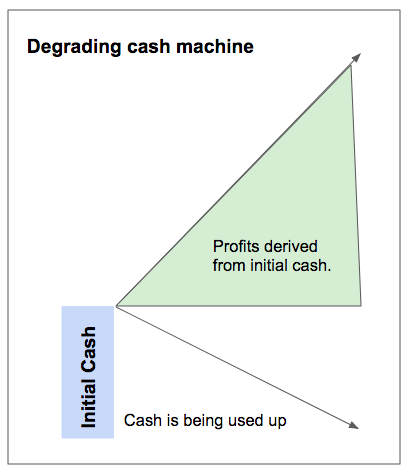
A slowly degrading cash machine
In the graph, “cash is being used up” stands for skateboards break down. This is cash because we have used the cash to buy them and cash generally is a good unit of account. The green thing is the cash generate over the lifetime of the business. It is bigger than the blue block, so that is quite nice. When the all skateboards are broken, nobody cares because they earned more than they cost over time.
Scenario 2 - Self refueling cash machine
The first scenario makes sense. The second scenario is that a company does not just stop after the initial budget is used up but actually takes a bit of the profits and does something with it to make more cash.
For example, instead of letting the skateboards break down, the company takes that cash and repairs/buys new skateboards. And ideally (!) can rent these skateboards for a higher price or at least the same price. More realistically though, the first skateboards that were rented out where rented out at the highest price and from now on the profits from skateboard renting drops.
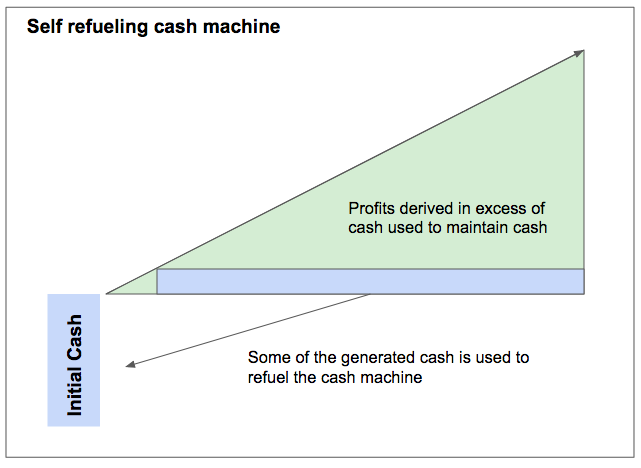
The self refueling cash machine
The issues is that the cash can be repleted from three sources: debt, selling of new shares or profits. So it is not as easy as this graph shows but I will learn from application.
Concrete terms for the company analysis
For the below list of companies I want to answer the following questions:
If I buy the company for a given price, will the company generate more cash than that price? (= scenario 1)
If I buy the company for a given price, will the company do something with that cash which enables the company to generate more cash in the future (= scenario 2)
These are the companies that I will put a value on:
ATOSS SOFTWARE AG
COMPUGROUP MED.AG O.N.
FABASOFT AG
FYBER N.V.
GK SOFTWARE SE
INVISION AG
ISRA VISION O.N.
MEVIS MEDICAL SOL.NA O.N.
NEMETSCHEK AG O.N.
NEXUS AG O.N.
PSI SOFTWARE AG
RIB SOFTWARE SE
SAP SE O.N.
SOFTWARE AG O.N.
USU SOFTWARE AG

You do have the time to read
I have checked how much I read in the last months and did the math of who that adds up and how much I can read and roughly do read per month. Interesting figures.
The purpose of this blogpost is to understand better how I read. In the first 4 month I have read the following books. This is only the ones that I have read from beginning to finish, I read chapters in other books, magazines etc. - but this does not count.
Don’t mean to show of here - I need to go to amazon to check the number of pages anyway so I put the names of the books here in case anybody is interested.
- The Snowball: Warren Buffett and the Business of Life (832 pages)
- The Acquirer's Multiple: How the Billionaire Contrarians of Deep Value Beat the Market (152 pages)
- Setting the Table: The Transforming Power of Hospitality in Business (332 pages)
- The Effective Board Member: What every board member should know (280 pages)
While, I am at it I checked Audible where I have finished “A Man for All Markets: From Las Vegas to Wall Street, How I Beat the Dealer and the Market” and “More Than You Know: Finding Financial Wisdom in Unconventional Places” and “Principles: Life and Work”. That has accounted for a total of 24 hours which is tracked by audible. But this is ignored here.
Anyway: I have read 832 + 152 + 332 + 280 pages. Average reading speed is 2 minutes per page. That means I have spend (832 + 152 + 332 + 280)*2 / 60 = 26 hours reading.
How reading fits into my week
Four months have 16 weeks. I am breaking this into weeks because it is easier to do the math.
30 min U-Bahn / S-Bahn trips per week: 2
2-hour trips (train/plane) per week: 2
From this we have about: 5 hours reading per week during these activities (2*0.5 + 2*2). 5 * 16 = 80 hours.
Thus: it is actually super easy to read one book per month at average reading speeds because most book have around 350 pages which means they take about 11 hours. If you claim you do not have the time to do it than you are probably lying to yourself - either you read bad books or you do not actually like reading.
Yes, you can claim that you are doing other stuff (working/calling) during these trips but I am pretty confident that reading is actually the best use of that time. With bad internet, posture and cell phone connection and interruption you are typical not focussed enough to be able to work.
In fancy language - the marginal utility of any activity other than reading during the above defined activities is extremely low but the utility of reading is no impaired. But, if you are not actually interested in reading than you utility from reading is low in the first place.
That is a cool why of saying - people who do not read probably do not like to read.

Measuring focus
A quick personal article about how I measure and try to improve my focus. This is done by trying to reduce non focus. Non-focus is mostly mobile phone usage which is thankfully easy to measure. Thereby, focus becomes measurable as the absence of non focus.
Focus is important because for hard problems useful idleness needs to be accompanied by hard focus to get things done, make decision and solve difficult problems. I felt quite unfocussed for a long time, and now feel as if I had become much more focussed after quitting to smoke.
But, the problem is that it is hard to measure focus. What to do? My attempt is to do it like they do it in statistics - instead of confirming the hypothesis, reject the negation of it.
Personally, the biggest killer of focus is my mobile phone. Facebook and linkedIn are blocked on my laptop but I manage to spend too much time on twitter/linkedin/newsreading on my mobile phone.
Step 1: Hence, I use an app called "App Usage" that tracks how often you unlock your phone, which apps you and so forth. This information exists on the phone anyway, the operating system know what you are doing - this just highlights it to you.

Step 2: I have removed email from the bottom launcher of my mobile phone.
The theory is that unless one has dedicated time and really wants to simply "opening" the email account just creates stress and has high opportunity costs. Because the time sitting in the bus and reading emails could be spend thinking which is often more valuable than random replies to emails.
Step 3: Probably nearly everybody would agree that keeping a diary and understanding what you do day to day is good. I am very impressed by the people who can actually do it consistently. I can never do it for a variety of reason but not because I think that it is not a good idea.
As with many habits, starting with a tiny version step is much better than not starting. The same goes for this post which definitly has many flaws but is still better than it not existing. So, the tool that I have discover and consistently use is Daylio.

A form of micro-diary that allows you to log your mood, defined activities and something else you want to capture. The basic form, so without editing text takes about 15 seconds to do. If you have set useful things to track, this becomes a good tool at understanding what you actually do.
So far, this is really insightful - if it does not lead to better habits straight away it at least generates the understanding of ones habits.
Here I include phone usage as a proxy for focus but also, as you can see sports, alcohol and writing.
Hope you find this useful.
2018 Bezos Letter to Shareholders
Brief and personal review of the 2018 letter to shareholders by Jeff Bezos. I want to learn more about how this company deploys capital and builds products.
A good way of the doing something is forcing one to take notes. A good way of taking notes is taking these semi-public. That is why this year I am doing very fast notes on the Bezos letter.
I do not have an opinion on Amazon as a business but organisationally find it amazing what they achieved to run all these different products successfully in one company.
The letter is found here:
https://www.sec.gov/Archives/edgar/data/1018724/000119312518121161/d456916dex991.htm
Introduction
Following from the great rankings that amazon shows in customer success surveys according to the letter, the topic is how those are achieved. High standards is the answer according to him. That is an interesting discussion because arguably my standard are quite low for a larger number of things (like these blog posts, my clothing style) but quite high for other things like actually DOING these blogposts.
What follows is a discussion whether standards are intrinsic or trained, universal or domain specific and elements like that. More or less insightful.
But than again really interesting is this story:
Perfect Handstands
A close friend recently decided to learn to do a perfect free-standing handstand. No leaning against a wall. Not for just a few seconds. Instagram good. She decided to start her journey by taking a handstand workshop at her yoga studio. She then practiced for a while but wasn’t getting the results she wanted. So, she hired a handstand coach. Yes, I know what you’re thinking, but evidently this is an actual thing that exists. In the very first lesson, the coach gave her some wonderful advice. “Most people,” he said, “think that if they work hard, they should be able to master a handstand in about two weeks. The reality is that it takes about six months of daily practice. If you think you should be able to do it in two weeks, you’re just going to end up quitting.” Unrealistic beliefs on scope – often hidden and undiscussed – kill high standards. To achieve high standards yourself or as part of a team, you need to form and proactively communicate realistic beliefs about how hard something is going to be – something this coach understood well."
Here takes that story and brings it on to it's memos that Amazon famously does instead of power points, here the lesson is:
"Here’s what we’ve figured out. Often, when a memo isn’t great, it’s not the writer’s inability to recognize the high standard, but instead a wrong expectation on scope: they mistakenly believe a high-standards, six-page memo can be written in one or two days or even a few hours, when really it might take a week or more!"
In personal productivity, scoping is essential. For example, in writing this blogpost my scope and standards are very low. That gives me the freedom to just produce and get it out.
Business Updates
- > 50% merchandise sold is 3rd Party
- Amazon Echo: nothing interested here on first sight, I have an Amazon Echo but use it as often as I use chat bots: nearly never.
- Good news on Whole Foods: "Our Prime member exclusive promotion broke Whole Foods’ all-time record for turkeys sold during the Thanksgiving season" ;)
- Updated kindle is waterproof. This was already known. Still I'd love amazon to work harder on this product, I believe there is much more potential and a lower price point (no idea what the displays costs though) on the hardware, plus a better UX on the device possible. I still love it.
Best of from the 1997 Letter:
"We will continue to measure our programs and the effectiveness of our investments analytically, to jettison those that do not provide acceptable returns, and to step up our investment in those that work best. We will continue to learn from both our successes and our failures."
"When forced to choose between optimizing the appearance of our GAAP accounting and maximizing the present value of future cash flows, we’ll take the cash flows."
Other ressources:
Obviously recommend The Everything Store, but more importantly, check out this podcast from the great podcast series overall:
https://www.producthunt.com/posts/internet-history-podcast-118-the-birth-of-amazon-s-3rd-party-platform-with-john-rossman

Book Review - The Snowball - Alice Schröder
Brief review and notes on the book "The Snowball" by Alice Schröder on the Life and Business of Warren Buffet. To cut short: an excellent book for those really interested. 830 pages, well written, but still quite a lot.
I have gotten back to consuming more content in 2018. This includes books because I was lucky to hit a string of good books. These include More Money Than God: Hedge Funds and the Making of a New Elite", "More than you know: finding financial wisdom in unconventional places", "Memories of a Nation"
The latest book I finished is "The Snowball: Warren Buffett and the Business of Life " Alice Schroeder. Summary: extremely good book if you are interested in how investing looks like in practice and have an interest in business history. Highly readable (the author is both a subject expert and a journalist) for those interested. Style-wise between a Michael Lewis book and Memories of a Nation or Postwar by Tony Judt. I would have estimated it at 400 Pages but as I just checked it is 832 pages (I read on kindle).
Themes:
1) Extreme Focus required for extreme success in on domain
The books shows effectively how extrem the focus, or in other words, sacrifice of things that are not in the focus is: relationships of Buffet to his wife and children. Very few experiences in travel outside of the US, no desire for other foods. Scences with Buffet not touching Sushi or things other than the plain items he normally eats are very entertaining.
2) Behaviour
Interesting to note that both Michael Munger and Benjamin Graham where apparently known for just leaving conversations that are not interesting. I want to do that from time to time and should probably do that more.
3) What is a good company
From a business perspective (defined as making more money out of money) the definition of a good company was extremely interesting to me.
The ideal business is one that earns very high returns on capital and that keeps using lots of capital at those high returns. That becomes a compounding machine. So if you had your choice, if you could put a $100 million into a business that earns 20% ($20 million) on that capital, ideally it would be able to earn 20% on $120 million the following year and so on. You could keep redeploying capital at [those] same returns over time.
Thats because the combination of generating capital and then using that capital in itself to generate more is a case for a capital allocation type job that makes sense. It is obviously also exactly what Berkshire Hathaway is.
4) Business history
A number of interesting things, including that Warren Buffet was the CEO of Solomon Brother and later invested in Goldman Sachs as well even.
I recommend to read this book.

Failed Apple Products
Another article written for myself. Failed products from Apple, the most interesting ones and who managed them.
his post accomplishes two things for me. First of all, I have to get my facts straight and remember them. Second, I have (anecdotal) evidence for what I believe in terms of product development.
I believe there are two roughly approaches of buildings products. One, is the visionary technology approach captured in quotes like “people don't know what they want until you show it to them.” (Steve Jobs). The alternative process is a jobs-to-be-done approach, that assumes that you can identify at least the problems that need to be solved and approach.
Summed up, you could look at the differences like this. This is extremely rough and definitely not mutually exclusive/commonly exhaustive.
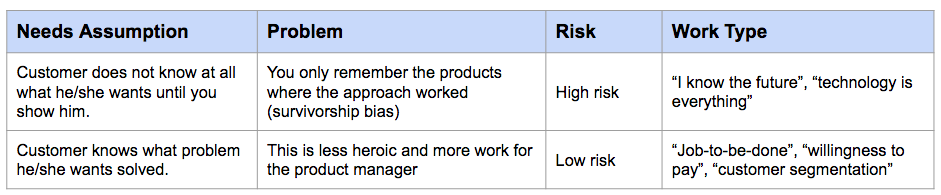
Definitely an incomplete matrix
The outcomes of the first approach can be very impressive, i.e. the iPhone. The problem is that if you only see the outcome and ignore the failures (= survivorship bias) it looks like that’s the only way to build. That is risky because in order to get to an iPhone-like product you need to have the stamina and cash to survive the failed product which you don’t see when you just look at the iPhone for example.
That is why I am listing some of the biggest failed Apple products here, to remind myself and those who read this. In any case, the iPod, the iPhone and the MacBook air are amazing products.
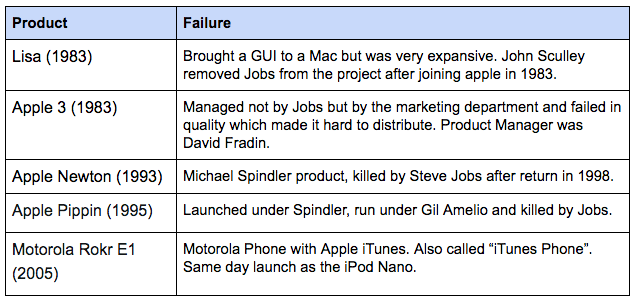
Incomplete list
The selection is not complete but based on what I find interesting.
On apple and this issue I recommend these resources:
- https://blog.aha.io/why-i-failed-with-the-apple-iii-and-steve-jobs-succeeded-with-the-macintosh/
- https://shows.howstuffworks.com/techstuff/how-apple-survived-the-pc-wars-part-one.htm
- https://shows.howstuffworks.com/techstuff/how-apple-survived-the-pc-wars-part-two.htm#
- https://www.forbes.com/sites/chunkamui/2011/10/17/five-dangerous-lessons-to-learn-from-steve-jobs/#32e10fa03a95

Semi-rogue guide how to start a product management career
On the occasion of giving another lecture on product / product strategy earlier this week, I am also summing up super tactical tipps to find a product management job. This is pro-active stuff which is fun and will teach much more than just reading.
A number of "how to get a product management job" content exists and I don't intend to make another version of that. Instead, is my personal approach that is a bit more rogue for people really interested in stuff, not only how to find a job. If you do want the other type of material, start with good product manager, bad product manager.
If you are interested in a bit of rogue action, this will take you about half a day on a weekend and be a lot of fund and very interesting. Basically, what I have done in variations at different points.
Now, simply because this blog post looks stupid without further text I am adding some copy here. Among other things (relevant when you read the slides), it might be good to know that publishing a blogpost like this takes about 3 minutes on the technical side but much, much longer on the writing side. It is actually the creative work that takes the time, not the technical.
Anyway, please enjoy the slides and tell me if they are helpful or not.