Review: Pricing Strategy Optimization Specialization on Coursera by BCG and Darden
This is a quick review of the coursera course Pricing Strategy Optimization | Coursera by Darden University and BCG. I have completed the first quarter of the course "Cost and Economics in Pricing Strategy" and highly recommend the course.
This is a review of the Coursera specialisation Pricing Strategy Optimization hosten by the Boston Consulting Group and the University of Darden. I looked at this course because one of the first Coursera I have done was the Introduction into Strategy course - also by the University of Darden.
Plus, I am always interested in
- teaching (interested in how BCG does it)
- learning
- pricing
I am extremely interested in pricing. This is for three reasons: Next to the number of units sold, the price of a product is the most important element from which the distribution (marketing and sales) and production and design decisions flow. It determines the market size and the profitability of the enterprise.
Having completed week 1 and week 2 of the first course my recommendation is simple: definitely start the course and see what you take out of it. The content is dense and excellent. The focus is on understanding concepts but includes some light but powerful explanations.
That is it - just test the course for free. It is very much worth to understand a bit of pricing, the most important number in business from my point of view.

37% Rule and Maximiser vs. Satisficer
Decision making analysis is an interesting problem because there is only a) available information b) analysis of that information and then c) using that information for decision making well. I am summing up a number of thoughts here quite fast.
The following was triggered by "A Man for All Markets: From Las Vegas to Wall Street, How I Beat the Dealer and the Market". The book is super fun, very similar to “You are Surely Joking, Mr Feynman” if you read that.
It is also based on constant experience where group decision making are annoying. Usually, these are joint trips. I tend to want to make decisions (i.e. define the date, book the hotel, book the plane) as fast as possible. My argument is that most things don’t really matter as long as the people are fun. If the people are not fun than the best AirBnB in the world does not change shit.
That's somewhat uncorrelated but still a trigger for this piece.
All this is obviously not my own thinking but a re-cap of what I read somewhere else. The primary texts are below. I have not read those but a mixture of Wikipedia and what I found online.
- Rational choice and the structure of the environment (Herbert A. Simon)
- The Mating Mind (Geoffrey Miller)
Decision Making Types
There are two types of decision maker.
Scenario:
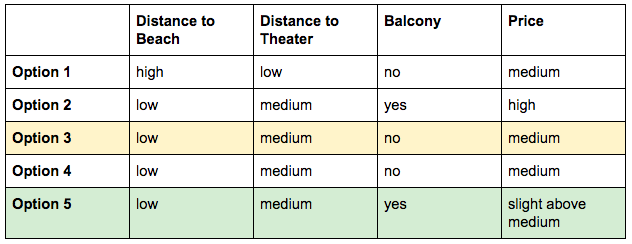
We are looking at a an apartment for a short trip. The factors are simple: how far is to the beach and to the Theater. Plus the some apartments are nicer than others, the placeholder for this here is a balcony to make it binary. The price ranks from low to high.
These are the options:
Satisficer:
The Satisficer defines a basic criteria and takes the first options that meets the criteria. So if the criteria here is to be close to the beach and pay a medium price, he/she would take option 3 and stop evaluating and get on with life.
That saves time but leads to the satisficer missing option 5 which is the same as option 3 but has a balcony. Yet - crucially - the search costs are higher for the satisficer than the benefit a balcony brings.
Maximizer:
The maximizer also starts with a baseline. Say, the criteria are the same as above, so distance to beach = medium or low, price = medium or low.
Once these criteria are fulfilled, the maximiser continues to maximise utility. So trying to take the get the best value for money. That has the issue that the options in the real world are nearly endless which in essence means that the only limit is the time spend in generating alternative options. That leads to unhappiness for Maximizers in general as the best value option cannot actually be obtained.
Extremely expensive ketchup for maximizer
Other than the cool word “satisficer” and that one can recognise people who fall in either category it is not obvious what the benefit of this concept is.
One story of how the concept is operationalised is very expensive ketchup. The suggestion is that supermarkets should add an obviously expensive version of a product in each category. A maximiser consumer considering different choices of ketchups with marginally different prices will not be able to make a decision because the time to choose would be too long.
But, as soon as there is a very expensive option the consumer is happy by “not taking that product”. Relative to the expansive option all the other options are good and hence the consumer can make a decision and be happy about them.
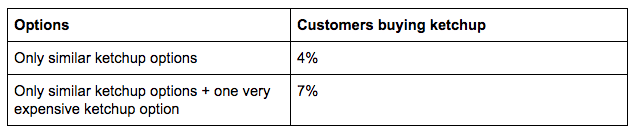
The point of the expensive option is not up-selling or a higher price. The presence of that option is entirely to increase the absolut sales of the the other options compared to a baseline without the expensive option.
I have no idea if this story is true, but it certainly sounds cool and it might as well be true.
The 37% Rule
This is also expressed in something called the secretary problem, the marriage problem or a variety of other names.
The set-up is this: you have n applicants. You interview them sequentially. You take a decision after each interview and cannot change it. Other key assumptions: having interviewed people you can judge the quality perfectly. The decision to accept or reject compares the quality of the current candidate to the past ones but ignores future ones.
The goal is to maximise the priority of selecting the best candidate. Since you cannot go back and accept rejected candidates and you can only “accept” a candidate who is better than the past the question is when to stop looking for a better candidate and take the next one who is better than all the ones before.
The answer is crazy: take the candidate qualified for acceptance (i.e. better than the previous) after n/e. At “reasonable” numbers 1/e which is 37%.
In other words: estimate your pipeline of candidates. Start interviewing. Stop at the best candidate after 37%.
(It is amazing that e would express itself here - I don't know enough about e to thing about this today)
Investitionen in B2B Software Unternehmen
Nach einer Reihe von eigenen Unternehmungen mit der International Finance Cooperation (Weltbank), Findsport.ru, Opinary, Partner der Wissenschaft UG, Hackerbay, Kontakt.io und anderen arbeite ich an Ookam Software. Ich gehe davon aus, dass ich die nächsten 20 Jahre mit Ookam verbringen werde und freue mich auf den Weg.
Unser Ziel ist die Investition in B2B Software Unternehmen. Allerdings nicht wie bei Venture Capital oder Private Equity mit dem Ziel Anteile weiterzuverkaufen. Wenn das Geschäftsmodel der Weiterverkauf von Anteilen ist, dann hängt ein Großteil des Erfolges an der Meinung dritter - von denen die, die Anteile kaufen. Wir wollen in die intrinsischen Werte, d.h. die Fähigkeit profitable Produkt zu verkaufen investieren.
Auf unsere Webseite schreiben wir regelmäßig über relevante Themen wie beispielsweise die Beziehung zwischen Lizenzmiete, Lizenzverkauf, SaaS und ASP Verträgen. Auf der anderen Seite beschäftigen uns die Aspekte der Unternehmensübergabe und Nachfolge in Softwareunternehmen.

Analysis: Constellation Software (TSX: CSU) /P1
This is an investing post. I am looking at constellation software (TSX: CSU), a company that has come up multiple times in the past months in podcasts/twitter/blog posts. Writing this as I am educating myself.
This is another type of post. I am writing as I am exploring a company that I have heard more and more about: Constellation Software. Source used are initially the public documents, so statutory filings, the annual letters of the CEO and elements like that.
I am writing here as I read and do not claim to do a deep analysis. The language is how I write, not artificially complex.
Product:
As the company state, this is a holding/investment company. The investment strategy is owning cash generative assets for a long term (as opposed to trading) and use that cash flow to buy other assets. So the cash flow stream does not come from product as such but it comes from the business that then have products. Those I am not looking at those right now, since I am staying at the company level.
Business Model:
In a "normal" business I would look at the unit economics of the products being sold plus the market size for them. Those products generate cash which you can use to make other products that again make more cash or give it back to shareholders.
This company is in the business of buying other companies. That means the company management basically does the product analysis described in the paragraph before. That is the basis of judging the management. Obviously one could form an opinion of the products of the company the management has bought, but this would be more of a qualitative assessment. The equivalent in a "normal" company would be to go on the level of product execution, like a particular advertisement campaign.
Given the above, there are two factors that matter for the business model:
- free cash flow of existing companies
- additional free cash flow generated buy the additional acquisitions
The first bullet point here is basically the running of the existing business, the second part is the "investing element".

Is Michael Porter wrong?
I am trying a new way of writing. Live commenting on the me reading a piece about Michael Porter, the author of competitive advantage and general strategy genius. The foundation for this is the piece "The Gospel According to Michael Porter" from the magazine Institutional Investor.
This is a new way of writing - I am live commenting (minimal editing) the piece The Gospel According to Michael Porter from the Institutional Investor magazine. This is of a lot of interest to me as I have read the key chapter of "Competitive Advantage", sometimes when looking for a strategic way out. It is also interesting to note that reddit has a good thread on this article: https://www.reddit.com/r/SecurityAnalysis/comments/7btb25/the_gospel_according_to_michael_porter/
Here we go.
Porter vs. Graham
The argument is that Porter claims returns are generated through power, whereas Benjamin Graham argues those that going against the consensus leads to outperformance.
Notes:
The take-way is obvious - writing while reading does not work. I do not want to end up re-writing the piece to comment on it. But, I leave up this post anyway, maybe it is still interesting. These comments are quite random, this is not a deep assessment of the piece.
- Power drives the need for market share in pricing
The author argues that the drive for market share is a result of the five forces theory. That is because power is equated with market share. This to me is very interesting since my preference outside extrem growth cases would be to manage on cashflow. Simply because I imagine it very, very difficult to run a large organisation successfully without clear metric. "Growth" is a much less clear metric than free cash flow because it also needs definition of growth in which sector and at what cost. Besides this more managerial point, the author argues that even if growth works, i.e. high market share is achieved this does not translate into profits. Interesting!
- Power as the methodology for anti-trust
It is quite fascinating that business and economic power sometimes does end up in front of a legal system. That is in the case of antitrust law cases. Here without going deeper into the issue which is fascinating, it is ruled that market share in and of itself is not proof of negative influence on the consumer (which would result in excess returns to the company). Read more here: https://www.justice.gov/atr/competition-and-monopoly-single-firm-conduct-under-section-2-sherman-act-chapter-2
- The author
Realising only after the fact that the author is Dan Rasmussen who has an interesting investing strategy by himself. Listen to a good podcast where he explains that here: http://investorfieldguide.com/rasmussen/

Win/loss Analysis for Product Managers
Win/Loss Analysis is a key tool for to understand why you are not growing your business. In addition it helps both investors and capital allocators understand where the value of a business really is. I walk through the key considerations here.
I have come across Win/Loss analysis late. I believe it is the most powerful tool to operate and analyse a product. Since a business is just a collecting of products, it is very helpful to analyse businesses too.
In a business, there are infinite number of issues one can discuss. For example: should we change the packaging? Hire in a Social Media person? Change the CRM? Buy forklifts instead of leasing them?
Upfront an example from booking.com:

Win/Loss Analysis by Booking.com
These are nice debates where everybody has an opinion but they are irrelevant as such. Your problem is know what you are solving for. It is not discussing the Pros and Cons of Social Media interns vs. an Agency unless that turns out to be the real problem.
So, we define our goal as knowing: what do we need to do to increase revenue?
Win/Loss Analysis - The Sales Process
Looking at selling a product backwards, there are three steps:
Customer either buys or doesn’t buy the product
Customer understand what the product does and it’s price
Customer is aware of the existance of the product
The product that I buy most often is books. For the absolute majority of books I do not know their existence. That is to say, if I’d search for books on “Australian folk dances” I would not recognise a single one.
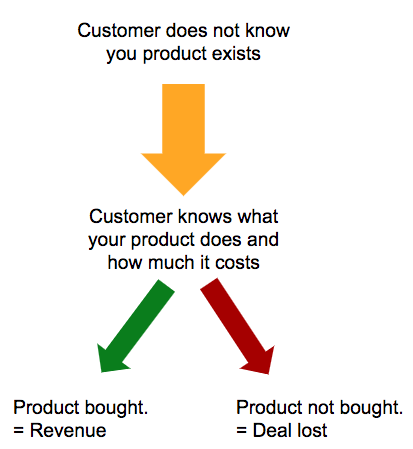
The steps to purchase
Other books, I am aware of and know what they are about, for example if I take the non-fiction section of the annual “FT/McKinsey” Book award list, I’ll know about half of the books on there. But have probably bpught only one or two.
Lastly, there are the books that I actually have bought. Those are the three steps that exist, obviously what they they are varies wildly by industry. The essence of the first step is that success at this stage is what you recognise as revenue.
For example, a free trial of a product is not completion of the last stage. It is the second stage because the customer has not bought the product. A customer walking buy your shop in a pedestrian area of a town is not in the second stage, because the customer does not know your products do and how much your charge for them.
Ignore the wins, look at the losses
Your goal is to sell the same product a more often. When you talk to customer who bought the product, they say things they need other than that. Does that help you sell the existing product more often? No. It helps you sell more to existing customers.
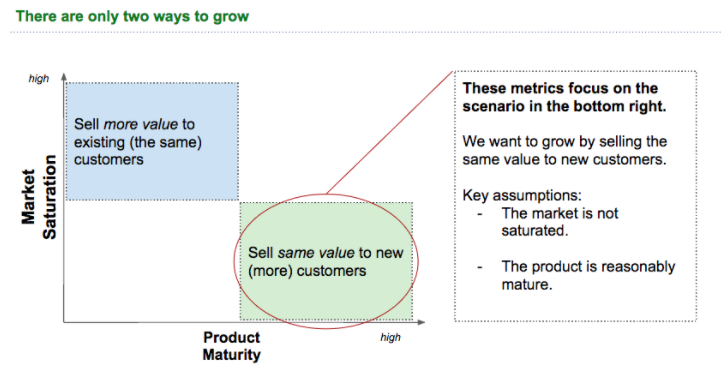
Do you want to increase the ticket size per customer or do you want more customer for the same product?
To find out how to sell more of the same product - you want to talk to customer who have not bought that product! The will tell you why they have not bought the product.
Let’s look at this example. You got 240 potential customers to the point that they know what problem your product is solving and how much that costs. Now, 12 people buy but 228 did not buy.
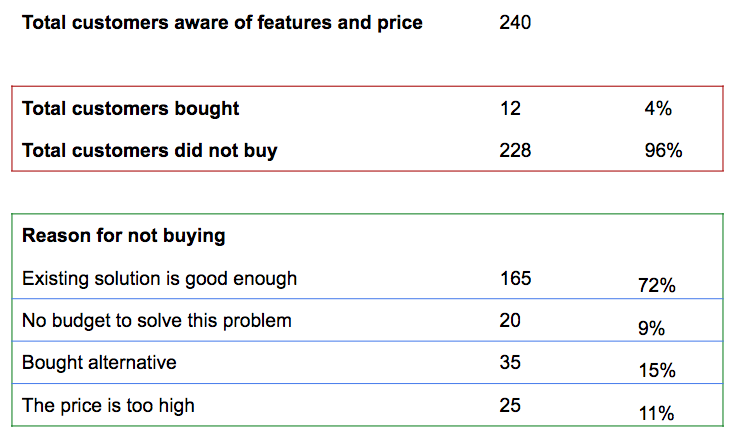
Simplified win/loss analysis
If you now look at the reasons why customers don’t buy it appears that the majority thinks whatever they are using is good enough. Since that is 72% of the losses you focus on that. Not whether you should hire somebody for social media because nobody is not buying because the lack of a social media presence. For those 72%, there are three options:
Your product is actually not much better than the alternative (product management problem)
You are unable to communicate the value (product management problem)
You pitch the product to the wrong people (product management problem)
Getting to the heard of this problem is what you need to spend your time on.
Digression for example at the beginning: discussing packaging as such is pointless if your customers buy online. It is only relevant for one goal: increase word of mouth business or improve rating to be listed higher as competitors. Word of mouth and reviews are not relevant than this is time wasted. Good for your ego and nice to discuss but not relevant for the business.
Win/Loss Analysis - What is your competition?
A key mistake is the perception of the competition. You probably think that your competition is Google, Siemens, SalesForce, Zappos, SAP or some other fancy company. Because of that, you think you need to offer stuff that Google, Zappos have - like massive customer success operations, be at expansive conferences, have a big twitter team.
This is a mistake and it is an expensive mistake. Your competition is whatever the customer are using to achieve what they want to achieve. Nothing else. For example I buy a lot (too much) clothing at Uniqlo. Quite often I try something on and consider. In the absolute majority of the cases where I do not buy a new jumper, I do not go over to H&M or Zara and buy the same thing there. I fall back to loads of existing jumpers or some free start-up hoodies that constantly gather.
Uniqlo is not competing against H&M and Zara for my Euros but against free start-up hoodies and something bought abroad for memory.
This holds true in B2B as well. For example, let’s say you build tools to collect 365 Degree Reviews from team members in order to improve promotion in companies (made up example).
When you are selling this to companies you believe you compete with any of the tools that exists for that. But your biggest competitor is probably the fact that people don’t actually do 365 Degree Feedback.
This is usually the case. The competition is the status quo or non-consumption. People don’t actually have the problem you are solving.
What DO you need to do to increase revenue?
You need to do one of two things: reduce the reason why customers are not buying or make more offers to potential customers.
If you cannot reduce the reason why customers are not buying, while keeping unit economics sustainable, you probably want to exit this business. If the ratio of bought/not bought is healthy and there is a large available market you probably want to focus on getting your product in front of your customers. If you can’t do that your market size is the problem and you either want to build a nice boutique business or exit this business. (As for example happend to www.die-masterarbeit.de of which I co-founded).
Operationalising win/loss analysis
Doing win/loss analysis is inconvenient and not pleasurable. The problem is who does it. In my personal opinion it should be a key metric for the all product managers to consistently understand the win/loss rationale.
Also see my article on OKRs for Product Managers that touches on the same point.

My 2006 PPE Oxford Application Essay - Fixed Book Prices
This is an old application essay for the PPE at Oxford. I discuss the consequences of a fixed book price system for the German book market. Funny to read old essays.
Below you find my essay for my application to PPE (Philosophy, Politics and Economics) to Oxford in 2006.
Fixed Book Prices Revisited
Steffen von Bünau
November 1 st 2006
Introduction
The labour market in the industrialized world is shifting towards highly qualified jobs which require profile of the so-called “knowledge worker”. This is not a new development; neither is the term of the knowledge worker, in fact the term was already coined back in 1959 by Peter Drucker. The importance of knowledge has also been known as Winston Churchill predicted: “the empires of the future will be empires of mind”.
However, in the last decade the availability of information has also undergone a substantial shift, influencing the labour market. The internet has made more information available than ever, most of it being free of charge once the internet access is granted. One can estimate the role of the internet in information storage and supply by looking at the development of the gates to the information: companies like Google and Yahoo which core service is to supply mechanisms for finding information are growing rapidly. It is probably fair to say, that the
widespread of information leads to an acceleration in the importance of the knowledge worker. Most recently the survey “War over talent” in “The Economist” highlighted the role of skilled labour, particularly in developed countries.
Not surprisingly with a shift in the nature of labour, there is a shift in the requirements for that
labour. In relation to the knowledge worker, the most important skill is to work with
information. This skill is also vital for using the free resources available in the internet. The
key to the ability to deal with information is, to first of all understand it. Since most
information is available in written form this requires the ability to read. However important
the internet and new media are, most people still learn and improve their reading competency
through books. It is true that the internet helps gaining equal access to information, but only to
those with matching information skills. Therefore, the medium book plays a crucial part by
conveying those skills.
Government intervention in the book market is common in a lot of countries, but it varies in
methods. In Germany, for example, the agreement for fixed book resale prices is rooted in a
decision from 1888 by the so called “Boersenverein des deutschen Buchhandels”.
Another tool widely used in the EU is a lower VAT rate on books. Extreme cases are Ireland
and the UK where VAT on books is completely abolished. The discussion on resale price
maintenance resumed after the effects of a liberalisation of the book market were observed in
the UK. Resale price maintenance was abolished there in 1995. This change resulted in a
decrease in bookshops and an increase in book prices. The reason for the price increase could
also be a shift towards hardbacks, as the authors of “The economics of Books” Marcel F. M.
Canoy, Jan C. van Ours and Fredrick van der Ploeg argue.
In Germany, the interest in book market regulations rose, after the decision of the European
Union in June 2000 that the German resale price maintenance does not infringe the European
competition law. In October 2006, the weekly newspaper “Die Zeit” published an article
expressing doubts about the effectiveness of the resale price maintenance. Furthermore, the
discussion is fuelled by other changes in the book market such as the rapid growth of online
selling and publishing.
In this essay I will analyze the economic consequences of the German resale price
maintenance and I will try to answer whether the use of resale price maintenance is advisable,
especially under new market conditions due to new technology. Before assessing the impact
and effectiveness of the „Sammelrevers “(the name of the German rpm) I will give an
overview of its aims.
First of all it is generally agreed that a variety of genres and books has a cultural value, which
might not be reflected by a corresponding demand in the market. To enable and protect
diversity in the book market, therefore is a vital goal of resale price maintenance. To provide
a good access to literature, a dense network of quality bookshops is also desirable. The dense
network of bookshops is not only important under cultural aspects but to support reading.
The stimulation of reading is also the motive to keep book prices low: another aim of the
resale price maintenance.
The Consequences of Fixed Resale Prices
The advocates of the resale price maintenance argue that cultural diversity would flourish due
to cross-subsidising, allowed by resale price maintenance. Cross-subsidising is the use of high
profits in one sector to allow cheaper prices in another.
A common application of cross-subsidising can be seen in air travel, where seat prices in
higher class earn an extra profits which allows airlines to charge less on the standards seats,
then they would have to, if they were offering only standard seats.However there is a key
difference between the air travel market and the book market. In the air travel market, the
airline provides the service and can charge its price directly to the consumer.
This is somewhat different to book markets. Regardless how promising the prospects of a
book are, the publisher still needs to get it into the stores. In a market without resale price
maintenance, the point is that publishers would come under fierce price pressure in particular
from the big chains. They would earn less profit and concentrate on those books with very
little risk, since they want to minimize the risk of unsuccessful books, which they share with
the shops. Now the advantage of resale price maintenance is, that cross-subsidising becomes
possible to a greater extent, leading to a greater variety of books published. With the power of
setting the resale price the publishers can raise the price they charge the book stores, by also
raising the price the book stores charges the costumer. Without the ability to set the resale
price, the publisher would possibly have to charge less in order to get the books into the stores
at all. The hope is, that the publishers use this extra profit to subsidies riskier books.
Opponents however argue, that publishers do not necessarily use the extra profits to subsidies
books of higher risks and cultural value. They might just take the extra profits and continue
concentrating on bestsellers. It is also argued that the concept of cross-subsidising riskier
books is itself undesirable: the point is, that riskier books are more likely to be of an esoteric
character which generally is favoured by people with higher education. But people with
higher education also tend to earn more than and less educated people might generally favour
bestellers(low risk books). Now those riskier books are subsidised by higher profits from
books with lower risk. In conclusion, the danger is, that less educated, possibly poorer people,
pay higher prices than they would, subsidising books which are read by people of higher
education and higher income.
Furthermore, the loss of price competition due to fixed resale prices is seen as an advantage
by the proponents. They hope that bookshops might engage in non-price competition such as
providing better service, general advertising or other activities fostering a culture of reading.
Naturally, opponents of the resale price maintenance interpret a lack of freedom as a
disadvantage. The argument here is not that the general level of prices could be lower but that
price discrimination is not possible. The idea behind price discrimination is that different
prices are charged for the same good, not based on different production costs. If possible it
might result in lower prices for pupils or people of old age, like it is common in cinemas or
theatres.
In order to guarantee a high level of geographical availability a dense network of high quality
bookshops is desirable. Resale price maintenance is said to protect individual bookshops
against chains, because they cannot be forced out of the market by price competition. This is
supported with data from the UK and Germany. In Germany the largest chain Thalia holds
only three percent of the market whereas 18% of the UK’s market in 1998 is hold by WH
Smith. However, this can be seen as a shallow argument since chains get bulk discounts from
the publishers and therefore can achieve higher profits from each book. More importantly,
chains have capacity to also compete in the non-price arena. For example, chains can invest
more in stores in better locations with more comfortable interiors or goodies such as free
coffee, newspapers and internet.
The issue of resale price maintenance is a very controversial one, a variety of opinions exists.
For example the essay “Resale Price maintenance for Books in Germany and the European
Union: A Legal and Economic Analysis” by Prof. Dr. Jürgen G. Backhaus and Dr. Reginald
Hansen published in the “International Review of Law and Economics” concludes that the
cultural affects are “by all means more important than anti-trust aspects” and therefore rpm in
the book market is to support. This is a contrast to “The Economics of Books” by Marcel F.
M. Canoy, Jan C. van Ours and Fredrick van der Ploeg whose concluding remarks are more
reluctant.
Most scientific articles base their conclusion on the resale price maintenance on their
judgement of the effects of cross-subsidising. Indeed it is probably the strongest argument on
cultural grounds but its impact is doubted.
When not taking the cross-subsidy argument into account a majority of arguments stands
against resale price maintenance of books. In the next section, I will not try to verify or falsify
the argument of cross-subsidising but instead show that its importance is diminishing under
changing conditions.
The World has Changed
Books have a fixed set of standard properties and are easy to send which makes them a very
well sellable over the internet. Online book stores like amazon.com or the online shop of
Barnes & Noble are growing and now move into other goods as well ( “Lifting the Bonnet” 5th Oct. 2006 in “The Economist” ). Since online-selling of books is growing, it is questionable if
bookshops really are the key to adequate book supply.
This trend is likely to continue with younger generations more and more used to purchase
goods over the internet. Of course, actual bookshops still possess certain advantages, probably
most importantly the personal recommendations by qualified staff. But then, this is known to
online shops and they successfully provide sophisticated substitutes. Recommendations in the
form of “If you liked this book you’ll like this one” and personal favourite lists compensate the lack of personality to a degree depending on the shopper. Future generations more used to
online shopping might not judge the absence of real personality heavily.
I think it is necessary to once again reflect on the cultural aims. Is the aim really just to
provide geographical availability (on which online selling would have a huge impact) or are
bookshops as an institutions given a cultural value? Book clubs and literature societies might
grow around a local shop and definitely be of cultural value. So it needs to be clarified if it is
sufficient supply chain or actual book shops which shall be supported by the resale price
maintenance. For simple availability, the need for having a dense network of bookshops is no
longer obvious.
The second influential point also involves the internet, but not on the consumer side. The
business of publishing books is also changes, maybe publicly not as well noticed as the
growth of online selling. On-demand publishing gives the possibility to publish at low risks
and costs. Consequently, authors who might have not passed the former standard examination
procedure, aimed at reducing risks, might now get their works published.
I am aware of the fact that a book published by an on-demand publisher is unlikely to attract
the same level of publicity as books from conventional publishers with powerful marketing
machinery. But I suspect that this might change as well. The internet has introduced a variety
of new opinion sources like weblogs and forums, and the impact they have is not clear yet. I
reckon that they might become extremely influential. In “The Economics of Books” the
importance of mouth-to- mouth culture in book advertisement is highlighted. I argue that it
might not be wrong to consider weblogs as possible successors or at least as very influential
to the mouth-to- mouth culture in future. This is due to the concept of weblogs involving a
high level of interaction in comments or votes which creates a strong personal attachment to a
blog.
Conclusion
Reconsidering resale price maintenance under these new circumstances makes it easier to
come to conclusion. The main reason on which the resale price maintenance is based -
promoting cultural diversity by cross-subsidising - becomes less important. On-demand
publishing and worldwide book purchase should provide a lot of variety.
Under these aspects, I value the arguments against resale price maintenance higher. For
example, I consider price discrimination as generally beneficial for overall supply of books to
groups with different financial resources. However, I believe that government action is
needed, but not so much for promoting diversity but to promote reading directly via strong
investment in primary education.

Favourite Podcasts - Product, Investing, Economics, History and Politics - February 2018
A review of which podcast in product management, investing, history and politics I am currently listening to. Plus, personal statistics of podcast consumptions.
Below, I am summing up my current status on podcasting”. As a record for myself (hence the data in the title) and in case anybody is looking for interesting podcasts.
Podcast tools
Subscribe to podcasts on mobile phone: I use Podcast Addict. I chose this about 3 years, paid for it and have my subscription there. Might not be the best tool but does the job for now.
Listen to podcasts on the web: through product hunt or alternatively whatever the website links to that I found googling for a particular topic.
Discovery: most often I listen to podcast when I am interested in a podcast (most recently types of investing other than venture capital). Then I basically google for that topic plus "podcast".
Favourite podcast episodes:
This is just a selection that came to mind while writing, so there are many other excellent episodes.
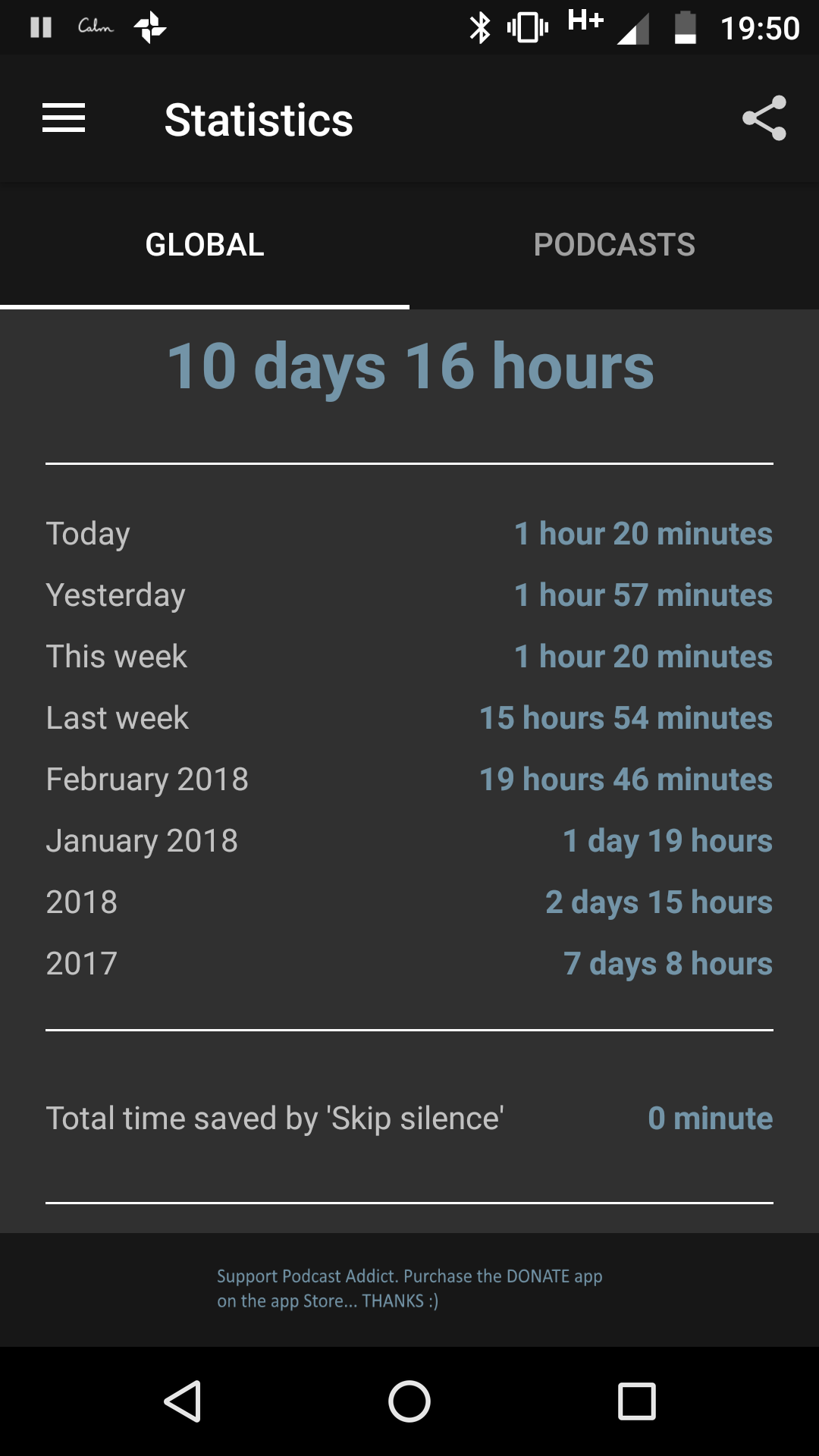
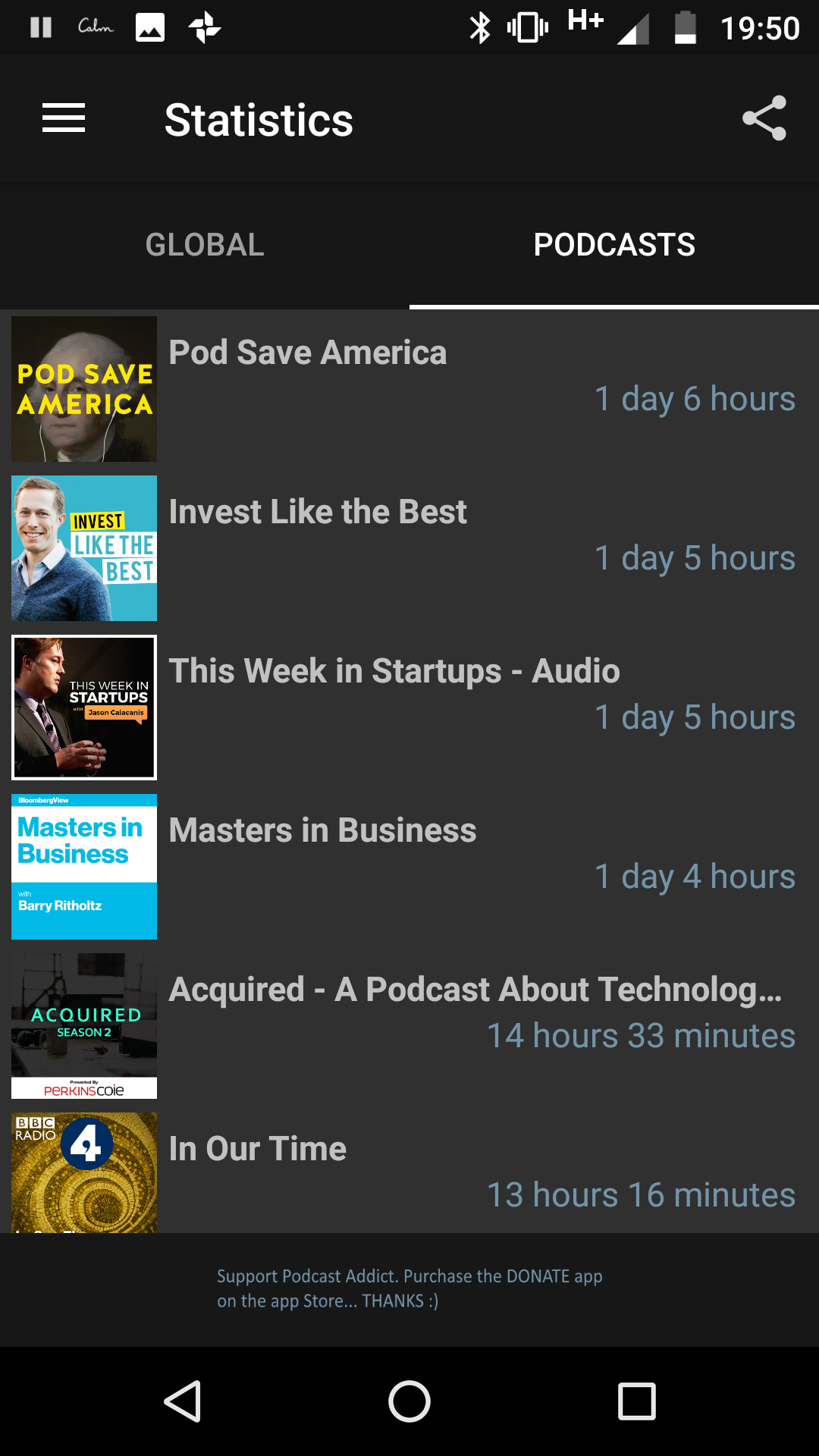
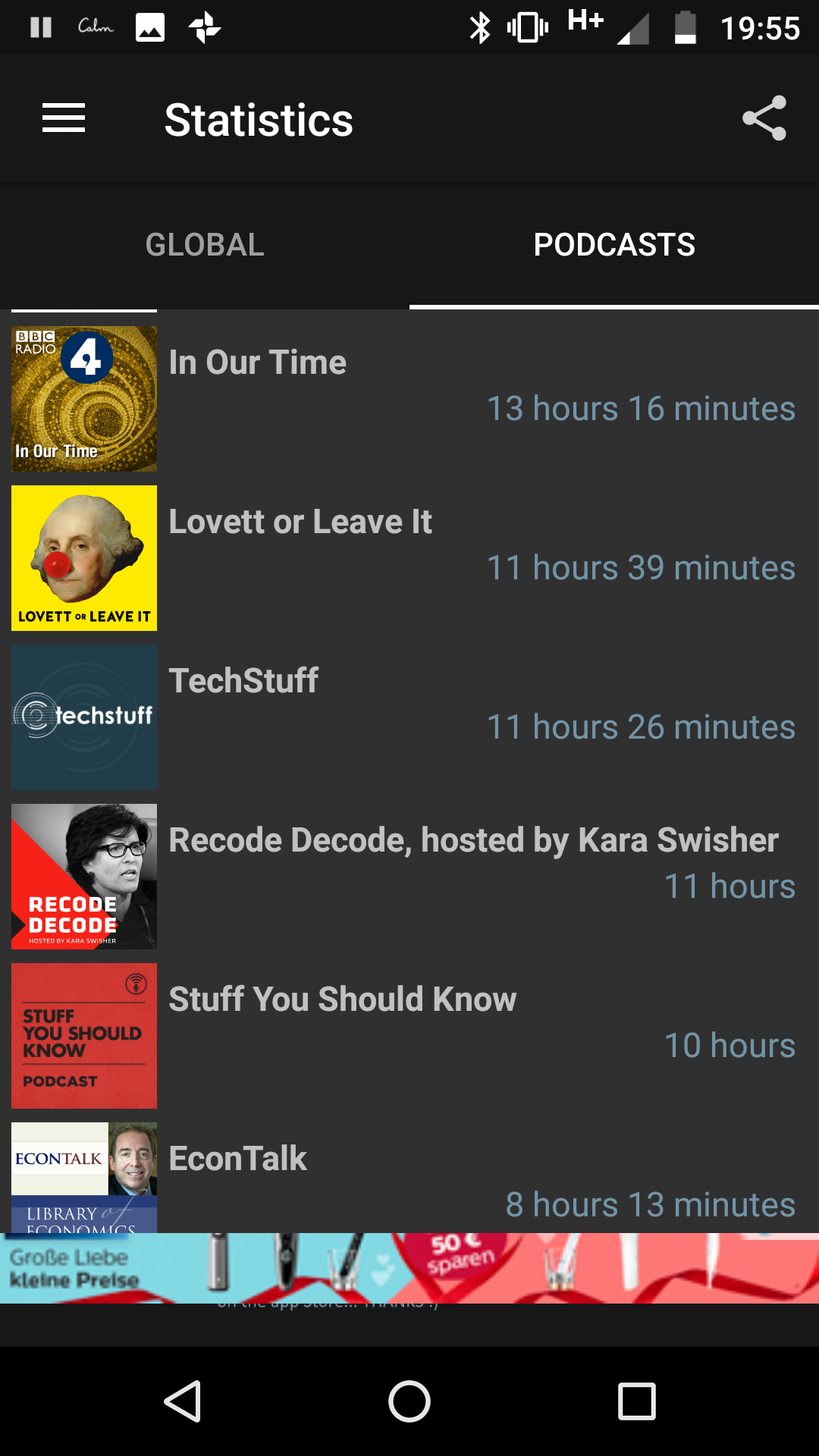
Current podcast listening statistics
I listen to podcasts usually twice for 30 minutes commuting to work plus when travelling (way to airport, in plane or train) when I am not reading and when I do stuff like preparing washing machines. This results in the following statistics:
Favourite Podcasts in Economics, History and General
BBC4: In our times podcast - Favourite Episode: P v NP. Extremely fascinating episode. Most of the podcasts are on niche topics but from any area: history, physics, politics, math. Beautiful BBC English.
Econtalk - On of the podcasts I have listened to for the longest time. Most non fiction authors of the type of Books that would be featured in the FT/McKinsey Non Fiction Book of the Year section come through here. Good start before reading the book. Brand name economists like Reinhart (from Reinhart and Rogoff) will show up here as do people like Acemoglu (Why Nations Fail).
Favourite episode: An excellent episode and a very memorable one is Adamati (Bankers' new Clothes) on the cost of equity and how to prevent housing crises. Very understandable for somebody who is not familiar with debt and equity concepts. http://www.econtalk.org/archives/2013/04/admati_on_bank.html
Stuff you should know
No favourite episode. Kind of an an american version of in our times - go through the topics and pick one that is interesting.
Hardcore History - Extremely dense and long history podcasts.
Internet history podcast - If interested in technology or particular companies or technologies from the beginning of the 90ies onwards, this is an extremely interesting podcast. Interesting are the Episodes on Tesla’s founding.
Lovett or Leave it - Entertaining American politics. Sometimes very specific US politics issues. Former speech writer of Obama and Comedian.
The Tim Ferris show - Look at the topics and choose.
Recode/decode - Look at the topics and choose.
Techstuff - Check out the topics and pick what interests you. The episodes on the iPhone are very good but I have listened to nearly all episodes because they interest me,
Favourite Podcasts in Business
Acquired - A history of famous tech M&A transactions and their effect.
Masters in Business - Very listenable on a variety of issues if you are interested in them. I enjoyed the episode with Ed Thorpe because I had been reading about him anyway.
A16z - Future oriented venture capital, the episode on self driving cars could be very interesting.
Invest like the best - Very much enjoy this podcast at the moment. A very fun episode was the a recent one on a variety of different exotic types of investing.
This week in startups - An extremely good podcasts on start ups by Jason Calacanis. The episodes with Chris Sacca, who wanted to be a Spy but then become a venture capitalist are extremely good. As is a more current episode on clean fish.
Meb Farber Podcast - Focussed on investing, I have not listned to many episodes but a current one on leveraging public value equities is quite interesting.
Official SaaStr Podcast - A tactical podcast on the many elements of running a SaaS company.
The IoT Inc Business show - In depth look at a number of IoT specific issues. A good episode compares the different types of protocols. Very useful for current product managers in the space.
Podcasts in product management
This is product management - probably the leader in the space so a bit of a must listen.
Clearly product book club - very good overview of a couple of books you are probably thinking about reading.
How I build this - NPR quality story telling.
There are of course a number of other great podcasts, for example from Deutschlandfunk (German Public Radio), Dittsche (the Hamburg Comedian) and stuff by established media like the economist or the FT that is worth listening to. Not going into detail here because those are somewhat obvious.