Transportation & Mobility Investors
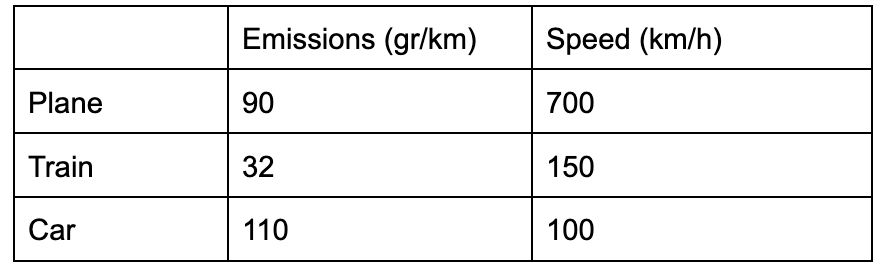
I am very interested in Mobility & Transportation. This is, because a very large part of the time of my life consists of getting somewhere or somebody else getting to me. Let's say I spend one hour per day in regular local mobility and another 8 hours per week in a longer travel, that is two hours per day. Given 16 hours awake, 2/16 = 12.5% of my life is spend in mobility or transportation settings.
For this to get better I want to understand the venture capital in new types of mobility. I would appreciate if you where to help me gather this data. It will always be shared.
List of Mobility & Transportation Investors / VC
Please help by editing this overview:
If we all do 10 min googling and 10 min editing this list is done quite fast.

Measuring Product Development Progress
In this post I provide options how to systematically get from a problem concept to a product with a price which could be build. Because it is systematic this approaches helps you how to manage the process of getting there.
As usual, this is written fast and I appreciate help to make it better - please point out typo's unclear sentences or arguments.
New product development is often a highly dispersed process. It usually starts with some sort of inspiration: A new technology has become available, there is a big media story in some magazine about a start-up that is doing something similar to your thoughts, a friend takes about exactly the issue you were thinking about., etc.
On the way to create a new product, there are basically three problems:
- How to define what progress is
- How do you measure your progress (and yourself)
- When do you decide to invest to build the product
How to determine whether it's a problem worth solving?
What you want to find is a problem, a price people are willing to pay to solve that problem, how many people have that problem. That is your market size and the cornerstone of you unit economics.
Normally, then this happens: you find a problem but you do not ask for a price. At home, you then do some more or less random math how much this could be worth to the customer or take the costs and add some margin.
The fundamental problem with this is: you have not found a market size. You have found a problem size. A market is a mechanism that clears supply and demand based on a price. Without a price you don’t know the demand size. You also don’t know whether you should supply that demand. Or - reductio ad absurdum - if I have a problem and you are selling me a product at a price of negative 10 USD I will buy quite a lot. Not sure, how your business is gonna go with that though.
Yes
“Do you buy shirts from time to time?"
12 - 15
“How many do you buy a year?”
No, sometimes they don’t fit and going to the store is annoying because the one I like closes at 6 when I am still at work
“Do you always find well fitting shirts in the right design fast?”
“Could we solve that problem by taking your measurements. We send you a sample of the cloth so you can touch and feel it. Whenever you need a shirt we will send you a perfect fit shirt with the fabric you chose.
Yes, that would be great.
Personally, I’d use this product/service at about 40 USD per shirt. Do the economics work at 40 USD per shirt? Definitely not. Am I part of the market: yes, at 40 USD (loss making for the supplier). No at anything higher (smaller market size for supplier). Or, you find some crazy technology or distribution that makes this work.
The point is, you need to put a price on the problem in the first encounter with the customer. Anything else is pointless.
Other things you want to know about your customer
Problem features - like how often and when it occurs, what is the measure of it being solved?
Customer profile - who is the person that will pay the price? Job title in B2B? Stage in life for B2C other things like that
Other - when did you talk, how could you reach him. If you decide to build the product this is your initial sales pipeline.
Execution Example
The trick is simple. You define what you need to know. You put that into a google form. After each customer interaction you are required to fill out this form. This forces you to gather the complete information that matter for the market size and the unit economics that drive your business.
So, let’s say we want to develop a tool for Digital Consultants to make their proposal writing easier. Also, we might want to sell insurance to them to protect them against a customer suing for not having fulfilled their proposal.
Next we identify the questions that matter. Below you find the screenshots from a questionnaire you find in full here: https://goo.gl/forms/ACovgeuniuEj5EGf1 - check it out!
Note, that I don't mean you send this questionnaire to the customer. Probably, it is more effective if you conduct the interview verbally and fill this out. In other cases, maybe you can actually mail this to people. This will depend on your product.
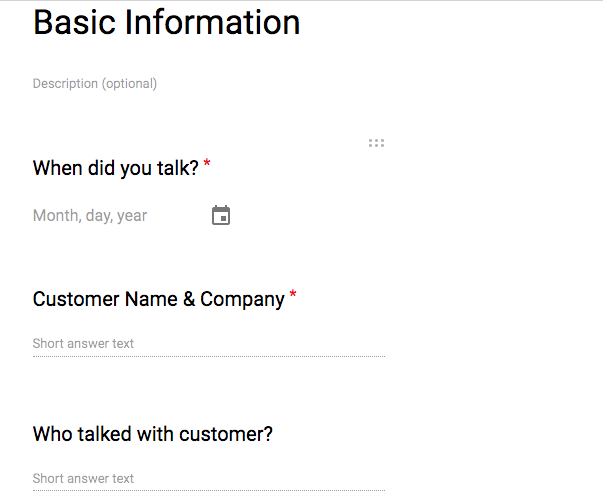
Here you want to capture things like the name, when you talked and who of your team talked.
Obviously you add whatever is relevant here. For example: how did you source this customer? Through linkedIn outreach? A friend?
Problem Questions
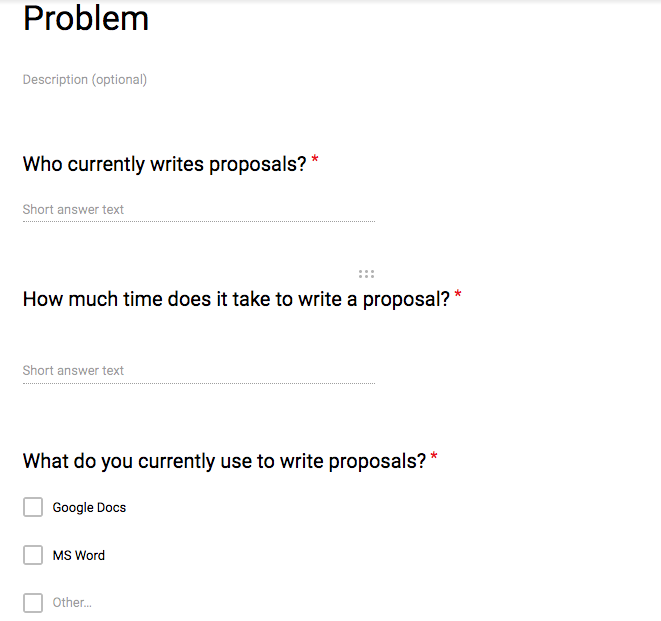
These are obviously key questions. If you cannot define them well, you need to clarify your (implicit) assumptions. This will also change as you start to do these interview. This will also be a key input for your marketing message. Because your product has only one job, solving these problems. So white papers, adds, direct emails will be based upon this.
Price questions
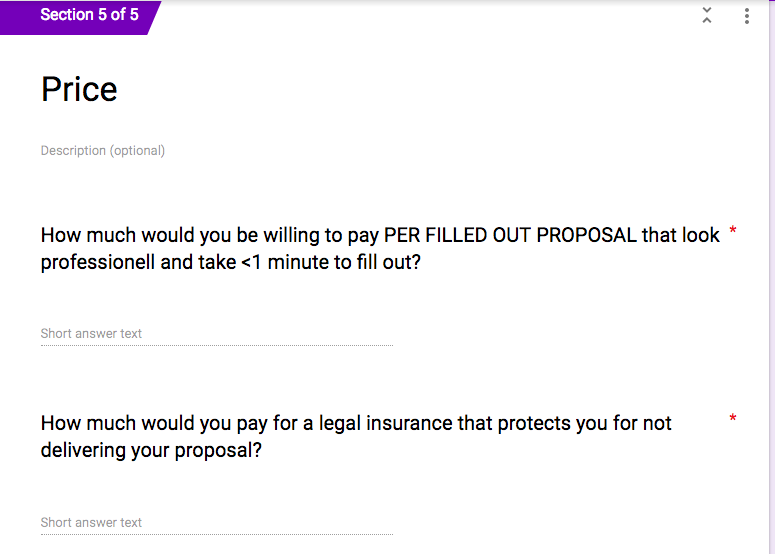
As we have discussed upfront - the price is the indicator whether the problems you have identified can actually be solved. You need two inputs to ask this well: the unit of the product (on-time vs. subscription vs. per unit of problem solved) and the price. This depends intrinsically on what you plan to build.
This is how they could look like for our example:
How do you measure success of product discovery
Above, we defined the three problems:
- How to define what progress is
- How do you measure your progress (and yourself)
- When do you decide to invest to build the product
Essentially, success is identifying a problem really well. Narrowing it down to it's core and - most importantly - attaching a price point to it. Together that gives you a definition of progress - point 1.
How do you measure progress and yourself: Well, once you have identified the questionnaire and include the questions on price you can pretty much measure yourself (or your team) by the number of fulfilled questionnaires. Obviously, you can still cheat yourself and there will be other inputs. But in general, everybody agrees that talking to the potential customer is the most important. Now, you have a number for this because you have defined what "talking to the potential customer" really means.
Lastly, when you decide to invest to build the product: well, that comes down to the number of data points (filled out questionnaires) that you are confident with. Obviously, you can talk to nobody and just build and you could talk to thousands of customers. That trade-off is yours to make but at least this is somewhat quantified by now.

Corporate Boards / Who is the customer? / p2
This article focuses on the corporate boards from a product perspective. It is inspired by the paper (and upcoming book) board service providers by Stephen M. Bainbridge and M. Todd Henderson. I am applying the first half of the value preposition canvas by Alex Osterwalder.
Part 2 of my thoughts on corporate boards. As usual, written fast and I enjoy critical feedback. This time the lens is on corporate boards as a product. As with any product the question is: who is the customer and whats the value proposition for that customer.

No more skating but boards are boards
The best framework for this from my perspective is the value preposition canvas - so I am going to use that step by step.
Customer Number 1: The shareholder. Probably this is most relevant for the "key shareholders". As in, in public companies these are most likely going to be concentrated shareholders.
I personally have no idea who is on the board of the companies I have stock in (though I just check the board of jd.com out of curiosity) because most of the time I have a couple of shares for fun.
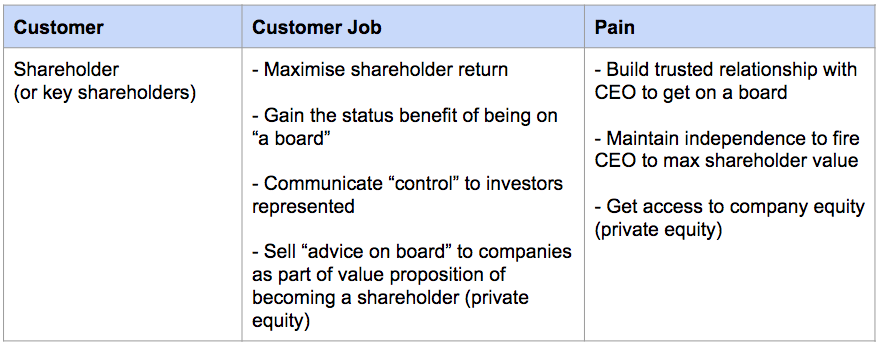
Who is the customer for corporate boards?
Customer Number 2: The CEO and probably the wider C-level management. I suppose that their what they want from the product "corporate board" could be outlined like this.

CEO has a customer of the product "board"
Now there are probably both other customer (minority shareholders, employees, the public) that I am missing here as customers.
At the same time there are probably jobs and pains that I am missing. Looking forward to learn and update.

Corporate Boards / Initial Thoughts /p1
Recently, two papers have increased my interested in corporate board members: "The Case for Professionell Boards" and "Boards-R-Us: Reconceptualizing Corporate Boards". This posts is my first in a series on board members.
I am starting to write on corporate boards for one reason: I don't understand why investors often are board members. It is not obvious that the skill, incentives and organisations imply that a good investor is a good board member or vice versa.
I also don't understand that if a board is the key high power gremium, how do some people (VCs) and public company CEOs manage to be on multiple boards even though they have a non trivial other job. CEO of a big company or investing fundraising and investing in more companies (VCs). I don't understand this.
The thinking was triggered by a number of conversations and the following research that lead to the The Case for Professional Boards (Pozen, HBS) and Boards-R-Us: Reconceptualizing Corporate Boards (Henderson, Henderson, Chicago School of Law).
As I am approaching this my thinking is not complete. I am writing to complete my thinking. Also, a number of the statements here depend on jurisdiction, I am aware of that.

Duty of a Board Member
Here, I made my first mistake. I believed that the purpose of a board member is to protect the interests of the shareholder he represents. That is wrong. The duties are lined up as follows:
A board member has a fiduciary duty towards all other shareholders
Basically, each board member has the obligation to maximise the outcome against all other shareholders and not just his/her own shareholders. In other words - the duty is against the company (= the sum of all shares), not the CEO, not the other board members, not the shares that the particular board member might own.
That fiduciary responsibility is broken into:
Duty of care
In essence this means that the fiduciary duty can be violated by the board member not being diligent enough. While attempting to act in the best interest (the motivation is right) a board member might be violating the fiduciary duty by not putting in enough work/considering and sourcing the necessary information.
This is in fact an interesting elements with regards to the above questions on the case for professional boards - is it possible to fulfil the duty of care at multiple boards while simultaneously running a company or investing? I am not talking about the intentions, those I presume to be good, just from a capacity point of view.
Duty of loyalty
Obliges board members to put the interest of the company first, their own interests or any other interests second. Obviously, that makes it complex for fund managers that have investors of the funds well.
That is that on board members right now.
Board Member vs Advisory Board Member
The difference is simple: a board member has a duty towards the company (see above), an advisor has the duty to whoever hired him or her.
An advisory board might also be called a "board" but has nothing to do with the corporate board. The obligations are to whoever hired them. Probably, an advisory board is comprised of senior/knowledgeable people expected to give an independent opinion as well.
Still, from a corporate governance (and therefore legal) point of view an advisor, advisory board member or the president of the advisory boards are essentially employees or consultants without any other duty. If they are paid in options, that changes nothing, just makes them an option holder.
That's it for now.
More Information -> Worse Decision with More Confidence
Decisions have two qualities: first, the quality of the decision, i.e. how right you are. Second, your confidence in you the quality of your decisions.
There is amazing paper that I learned from reading this article: https://ma.tt/2017/11/adam-robinson-on-understanding/
I recommend it.
Lübbensee Ferienwohnung
Der Lübbesee ist ein kleiner See in Brandenburg, etwa 50 Kilometer nordwestlich von Berlin gelegen. Im Vergleich zu einigen der größeren Seen in der Nähe von Berlin, wie dem Müggelsee oder dem Wannsee, ist der Lübbesee deutlich kleiner und weniger bekannt.
Hier sind einige mögliche Unterschiede, die den Lübbesee von anderen Seen in der Nähe von Berlin unterscheiden könnten:
Größe: Der Lübbesee ist kleiner als Seen wie der Müggelsee oder der Wannsee, was seine Gesamtfläche und seine Ausdehnung betrifft.
Beliebtheit: Aufgrund seiner geringeren Bekanntheit und Größe könnte der Lübbesee weniger frequentiert sein als andere Seen in der Nähe von Berlin. Das bedeutet, dass er möglicherweise weniger überfüllt ist und eine ruhigere Atmosphäre bietet.
Freizeitmöglichkeiten: Da der Lübbesee kleiner ist, könnte die Bandbreite an Freizeitmöglichkeiten begrenzter sein. Es könnte weniger Wassersportaktivitäten oder andere Einrichtungen geben, die an größeren Seen vorhanden sind. Dennoch bieten viele kleine Seen, wie der Lübbesee, die Möglichkeit zum Baden, Angeln und Bootfahren.
Naturumgebung: Der Lübbesee liegt möglicherweise in einer ländlicheren Umgebung als einige der Seen in Berlin. Dies könnte bedeuten, dass er von Wäldern oder Feldern umgeben ist und eine natürlichere Atmosphäre bietet.
Eine gute Ferienwohnung am Lübbesee ist schnell gefunden.