Transactional law - abstractions
The key mental models from transaction law summed up.
In business for some the law is the most important in any transaction or deal. For others, it is the details done by pesky lawyers. I have recently worked on a number of commercially relevant transactions. In particular, the worked focused on software licensing and support contract revisions and a series mergers of mergers and acquisitions. From this I amateurishly try to abstract what to me is the essence or key concepts or mental models of law.
The set-up: law is involved when something is bought or sold. Or rather, that is the type of law I refer to here.
The “something” - defining positively or negatively
There are two ways to define something - positively or negatively. A positive definition focus on what something is, a negative definition what something is not. Sounds trivial, but becomes relevant with uncertainty.

Let’s buy a house. The house has a garage, which we do not want to buy. In the transaction we might therefore say we buy the house. Or we might say we buy the plot with everything on it except the garage.
After buying the house, we make a discovery. The cellar contains two barrels of environmentally hazardous material, which we have to recycle at great cost. Is this our problem, or do the barrels maybe belong to the seller?
It depends on the definition initially chosen - if we choose to buy the plot with everything on it, probably it is hard to make a case that the barrel is somehow still the owners. After all, if we specified exactly what we don’t want to buy (the garage) and we did not put the barrels down on that list, so we must have planned to purchase them too.
On the other hand, we might find valuable silverware in the attic. Is this part of what we bought? If we bought a “house” than maybe not because silverware clearly is not part of a house. If we bought the whole plot, except the garage, then it probably is because the seller did not want the silverware to be included in the list of things we haven’t bought (like the garage).
In essence, the style of definitions matters - unless you know everything about something you buy, which you usually don’t.
Burden of proof
The “types of definition” is quite theoretically, the burden of proof isn’t. In the essence, even if law is mostly abstract at some point somebody has to actually do something. And that “doing” can be tiresome/expensive so it matters.
Now, assume we buy a company. The purchase contract states that the taxes were filed correctly in the years 2005 - 2018. Now, the tax authority demands payment for taxes in the years 2007 - 2015.
Proofing whether these taxes are caused by irregular tax filings or are part of the normal course of business is costly. It probably requires a taxation expert to dig into all the past filings at great detail and expense. Who carries the burden is decisive. Whoever is under the obligation might just decide to pay the additional tax and not do the inquiry.
Thresholds
Again, in the real world defining a thing in detail is often complex/impossible. A way around that is to delay the problem of definition by referring to a standard. For example, if we purchase a set of old wines, we might agree that they have been handled with “care that a wine lover would apply”. No, if a week later we find the wine to be undrinkable and suspect that this is the result of exposure to higher temperatures and sunlight, we’d complain that the standard of “care that a wine lover would apply” has not in fact happened. Now, two things happen, a) the burden of proof issue arises and b) specific knowledge is required because most likely courts have ruled on the question of what is part of the standard or care and what isn’t.
That’s it
In my understanding, this is what transactional law comes down to. Of course, in typical transactions this is masked by a lot of detail, complexity and procedural elements that are tricky.
For example, where we choose expensive silverware or barrels of hazardous waste, in the real world these items appear as pensions obligations or outstanding customer payments that might happen or not. That makes the work not easy, whilst it’s fundamentally simply

OKRs and KPIs for Customer Success Teams
OKRs or KPIs for customer success team should be clearer than "making the customer successful". In this post I outline the link of customer success team work to the company (product) strategy.
Again, a fast written article to get it of my chest. Appreciate your feedback to make it better.
Customer success teams tend to happen at a certain company stage. Usually when growth occurs and product, engineering and sales teams no longer want to handle the questions from customers. Plus, it is impossible to object to the notion of wanting to make customers successful.
Especially, when one also points to the book by the Zappos CEO and adds that Zappos was bought for 1.2$ billion. That is a true anecdote.
But, an anecdote is not an excuse of being clear how your customer success team fits into your business model.
That is true for three reasons:
NPS is meaningless by itself
Measuring and getting a high NPS (Net Promoter Score) is not the goal of a customer success team. Net Promoter Score means how likely are people are to recommend your product. This is a Marketing, Sales or Product metric, not a “customer success metric”.
At the moment, Netflix probably has the highest actual net promoter score in terms of generating new customers through people promoting Netflix to people they know. Yet, I have never been in touch with the customer success team of Netflix.
You don’t actually want a high NPS score, you want low customer acquisition cost. That’s a questions of sales and distribution tactics and not of asking people for their NPS score.
Or, to be more blunt: I’d give Wikipedia an NPS of 10/10 every day but I am pretty sure that my 25$ annual donation does not make it a great business model.
On the other hand, for all I know Herbalife preys on vulnerable people, is widely hated and in the center of many lawsuits by former customers. That does not speak for a great NPS. Yet, it’s market cap is at 85$ billion as of me writing this.
It’s a question of business model and product, not of “do you want happy customers?”.
Human support is expensive
The advantage of selling software products is that the marginal costs are close to zero. To provide one more Netflix account costs Netflix next to nothing. The problem is that well qualified customer success teams do cost a lot.
If your need for support increases linearly with additional sales then this need to baked into the unit economics of the product.
Who is not in customer success?
If there is a dedicated team for customer success, then what are the other people in the company doing? Is the goal of the product team produce a product that maximises the number of people that can’t use the product without a customer success team? Is the goal of the Marketing and Sales team to target clueless customers that need a lot of help?
Company Goals for Having a Customer Success Team
So you either account for customer success outside of the unit economics of your business, that would mean it is overhead. In this case you obviously want to minimise it. For example, by moving it down the value chain to your distributors, by replacing it through wiki’s and how-tos or by improving the product to minimise the need for it.
If that is not the case, then customer success has a part in your strategy. That then means it has goals that matter because your strategy matters. Find the goals below. At the same time, these goals serve as a check of whether customer success is part of your strategy. If your company does not have any of these goals carried by the customer success team then you know that it is overhead.
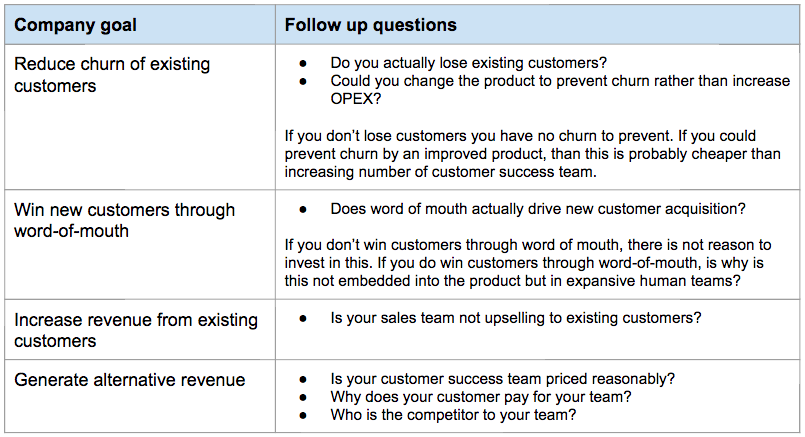
What should your customer success team achieve?
Company goals to customer success KPIs
Now, I understand that metrics are not everything. Metrics are only meaningful when they properly fit into the company strategy as we have seen above. At the same time, they are a good means to create an open discussion of what the actual goal is.
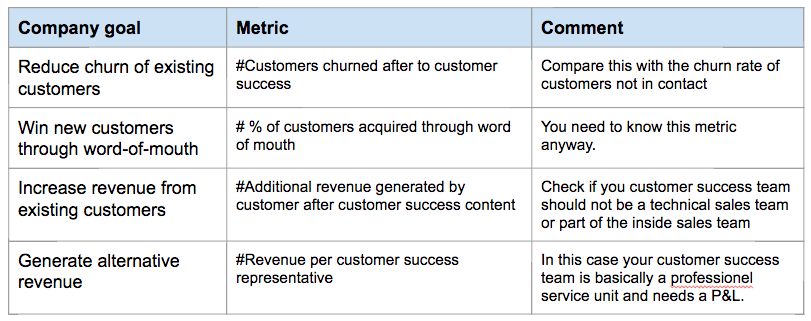
Simplified KPIs for customer success teams
Reduce churn of existing customers
In addition, you probably want to have the customer success team carry out a win/loss analysis (see other post here) so that you know why they churned. If they churn because they don’t need your product anymore then that’s a product problem, not a customer success problem.
Win new customers through word of mouth
This will massively depend on your customer acquisition game - is word of a mouth a demand driver. If yes, is that because of the value of the support? If that is true then you want to ask yourself whether your product has a high enough margin to pay for that and you want to account part of the cost to marketing.
Increase revenue from existing customers
Here, you are not preventing the loss of a customer (= churn) but actively work to increase revenue. Arguably, that is a sales metric and should be carried within sales and given elements like commission to align the incentives.
Generate alternative revenue
Potentially, customer interact a lot with you customer success team because it is free. That is not good. Everybody will love free help, no question. But if that does not lead to more revenue from the same customers (you need to prove this) or generate new customer (you need to prove this) then you are just giving stuff away for free. Why, should you pay for this time?
An interesting example on the consumer level would be toggl.com - after signing up you are immediately presented with the potential to use paid customer success. So as a customer you have the choice of figuring it out yourself or get paid help. That keeps the unit economics in check. Plus, it probably helps the product teams - problems that people pay for to get solve are probably not explained well enough.
Conclusion OKRs for Customer Success Teams
As always, the outcome is the same. Be clear what you want and don’t just do things because other people did it. Your business model is probably different.
Hope it helps and I am happy if you help me improve it or share it.

OKRs for Product Managers
Defining OKRs or Metrics for Product Managers is tricky. Based on the assumption that a product exists and the market is not yet saturated, this piece argues that product management OKRs should follow the funnel. In addition win/loss analysis as an OKR serves as a key business intelligence tool
Defining OKRs or KPIs for Product Management is difficult. Arguably, however good goals are important since product management teams can easily be drawn to the engineering side, the sales side or the marketing side and therefore need clear goals to prioritise actions.
Product Management goals depend on company stage
The first step is to clarify where you are in the product life cycle. In the following we assume that the team has a product in the market. In this case there are two options. Case 1: you want to sell more product to existing customers. Case 2: you want to sell the existing product to more customers.
Example: Let's say you are selling a tool to manage your suppliers. you might want to add an additional feature to handle supplier complaint management. If you plan to charge more for this additional feature than this would be case 1. You plan to sell more to existing customers.
An example of case 2 would be that you have so far focussed on selling the tool to car manufacturers in the UK. Now you want to sell the same tool to car manufacturer in Germany. This would be case 2.
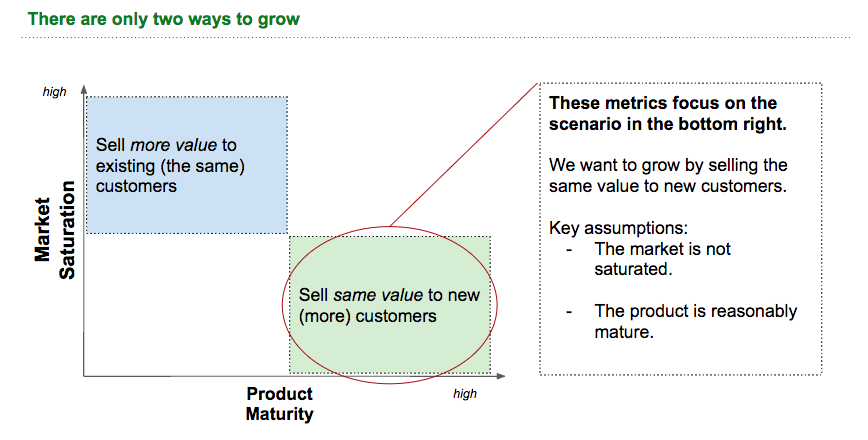
The two ways of growth
For the purpose of this article we focus on case 1. The key characteristics are: the product is mature but the market is not saturated. Whether these two assumptions are true will also be indicated in the metrics we are defining.
A good starting point on defining the size of the market is my article on Unit Economics for Market size estimations.
Product success is the indicator of good product management
Product Management teams have the goal to make a company successful by ensuring product success. Product success is unit sold. More precisely it is the contribution margin (= per unit revenue - per unit cost), however here we assume that the product is mature, i.e. a price is set and hence focus on units sold, not revenue.
But, we are not ignoring price - in fact whether we should decrease/increase the price is a key output of the metrics we are about to set.
In addition to the pricing element, the OKR system we are designing provides the source for key (company) management questions.
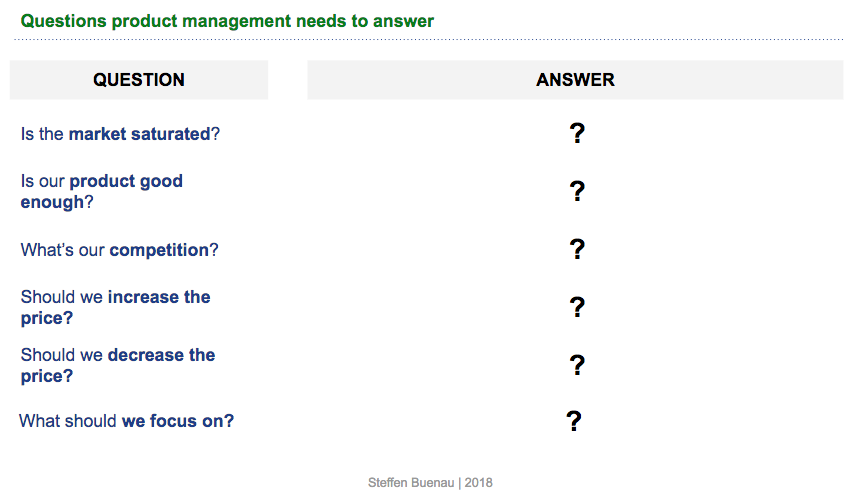
Good OKRs help us define the answer for these questions
OKRs for Product Managers need to follow the funnel
Since we have defined the context and the questions we need to answer we can now design the OKR system.
The rational is simple:
Unit sold (product success) come from proposals to potential customers. Specifically, units sold results from won proposals.
Proposals come from companies or people for whom the product could be relevant. These companies or people we call leads.
Leads are part of the ideal customer profile whom we have targeted either through outbound or inbound marketing activities. Outbound means we approach them first, for example through email or targeted advertisement. Inbound means they come to us, for example through product searches or referrals.
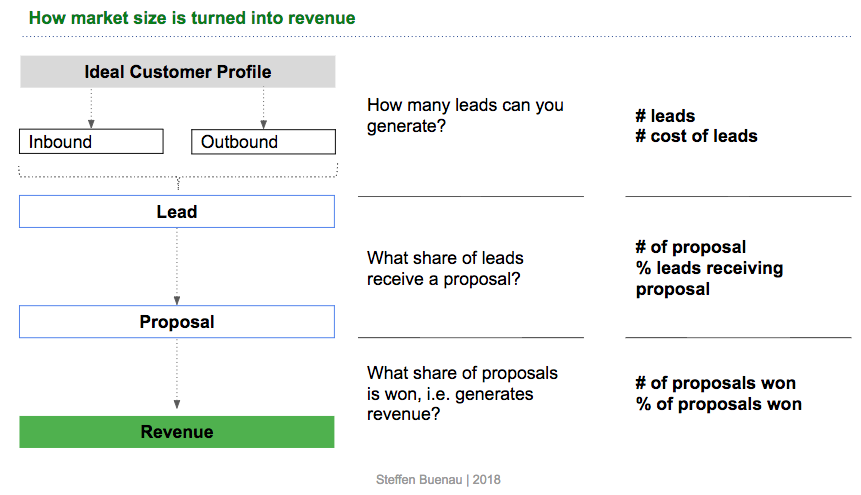
Product Management OKRs along the Sales Funnel
How to use the OKRs
OKRs along the sales funnel align the sales function and the marketing team but go beyond that into product specific insights through the incorporation of win/loss analysis.
The picture is simple:
Lead generation: product management is in charge of defining the target customer, price and features. In the assumed scenario this has already happend. Product teams now need to provide marketing with all that it needs to be able to reach the target customers effectively. These could be classic buyer persona's or things like useful content for the target market or participation in webinars. The problem is that this is not measurable.
Because we are need a measurable metric plus we do not want to measure activity but outcome the most relevant product OKR would be #of leads. Clearly, the execution and messaging is handled by marketing but two align the two teams in the interest of the company #leads is the most forceful tool.
Win/loss analysis: Since we assume a company set up with a Sales Team the conversion from lead to deal is carried by the Sales or the Sales Development Team. In other set-ups like in-app purchase business models these metrics could be carried by a revenue lead. I recommend to listen to the Episode "Revenue is Product Management" by the Mind the Product podcast.
A win/loss analysis will result in three key insights for the product team:
How many proposals do we have? If we do a win/loss analysis on all proposals we will automatically track the number of proposals that we have and understand from which customer profile they come from. This helps the product and the marketing team judge the effectiveness of particular marketing measures.
What share of proposals do we win and why? We care less about won proposals than we think. Generally, we want to know two things: are the won proposals enough to hit our overall volume goal, why did we win them and from which customer profile are they. The reason for winning we want to capture and use as part of our marketing message to the same customer profile.
From a pricing perspective, we want to understand if we could have sold the product to the same customer for a higher price.
What share of proposals do we loose and why? This is the most interesting insight for product management. Did we loose to a competitor or did the lead end up not buying anything for the job our product is meant to get done? If that's the case we might not be solving a problem that matters.
Did the customer not have a budget/means to purchase the good? Than we might need to change our target profile.
Did the customer chose a competitive product? If yes, this could mean the market is saturated or we are not doing a good enough job presenting our unique selling points or product advantages.
Did the customer not buy because of the price? If yes, why and how much lower would the price need to be for this segment of leads to win the proposal.
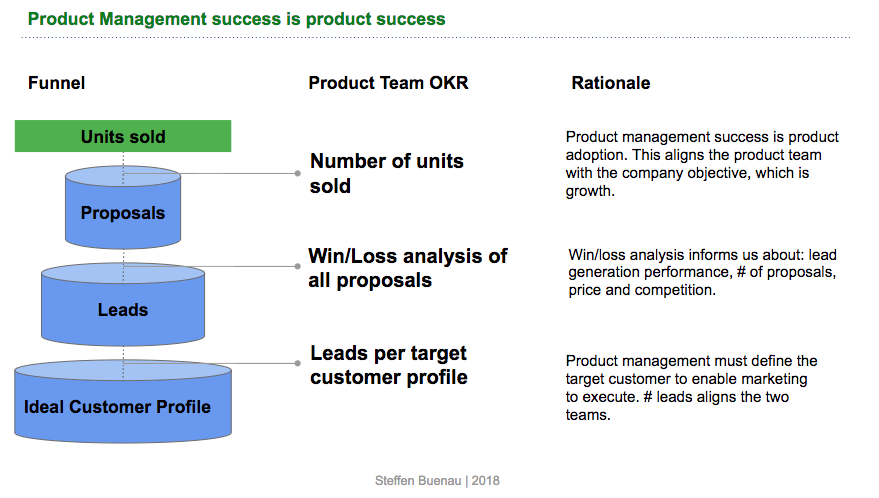
Beyond the product team - how do our OKRs help the company?
By following this metric or OKR structure we not only guide the product team on what is important: generating more leads that fit the profile, or winning more proposals we also deliver key insights to the management in general.
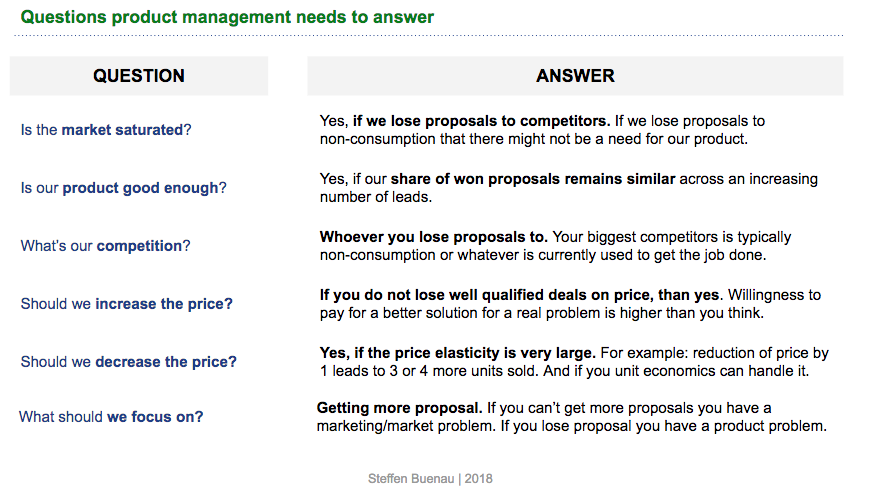
Based on the data resulting from the OKRs we can help the management answer the questions we posed above:
#Question: Why is there no market for failed venture capital backed companies?
Well, let’s assume there is a market. It would be for the shares of the company. The issues with venture capital backed companies is that the shares are not concentrated with one owner. After all, that is what venture backed means - founders sell shares to a VC to get capital into the company to grow. The alternative to selling shares would be to re-invest profits or to take debt. Usually neither is available, hence equity is being sold.
In the 90ies and prior, founders would sell a majority of shares to an investor, so that the investor in fact would have control. Yet power has shifted to the entrepreneurs. Today, founding rounds look roughly like this:

Ownership is on the left Axis. At the founding, Founder A and the Founder B jointly own 100%. Founder A owns 60%, founder owns 40%. Enter the seed investors (yellow), the series a investor (green) and the series b investor (orange).
Let’s narrow down the question “why is there no market for failed VC companies” to series a founded startups and beyond.
When would a venture investor sell?
For a VC selling its shares makes sense in a few situations.
One: branding value. Selling to a well-known company can bring status to an investor regardless of the economic benefit and increase status and make it easier to attract capital and entrepreneurs. Note that I do not mean this demeaning at all, it is just the business model of an investor. Warren Buffet does the same thing.
Two: economic value. If the investor believes, the current bid is the highest available during the planned holding period of the shares, than it makes sense to sell.
But what about a market for failed company
The question proposes, that the company is “failed”. Presumably, that means that there is nobody willing to pay a price high enough that would make all the shareholders happy. Venture capital backed companies are designed to be sold within 5-7 years, that is how the VC firms earn money.
Failed means - either there is no additional capital available for growth or nobody wants to buy the majority of the shares. The first option injects more money into the company, the second just buys the shares of the shareholders.
Of course, there is in fact a market for the shares when a VC fund reaches the end of a lifetime. It is in essence a distress position for that fund - shares can be sold back to the founders personally, to the company or to a third party. If the shares have certain rights, such as a drag along, the VC might also force the other shareholders to sell. But, since this is not much fun for any party involved it is not a heavily advertised market. Yet, it does exist.
What’s the current best practice stack for remote work? #Question
A new series to respond to questions in writing. Happy to answer any question: s.buenau@gmail.com.
This article is the first of a series. I respond to questions from a colleague or friend by writing a post.
Let’s ignore the technology stack for now and look at remote work.
The employee.
For which employee does remote work make sense? Three reasons:
The work is better done outside the office
For me, these are things like reading contracts, doing deeper thinking and strategy and sometimes writing. Other tasks, like going through the pipeline, following up and handling
The worker is not where the work is
Sometimes a company does not have an office close to an employee it wants to work with. Than, remote work is the only way out.
Same amount of labor but different sequencing of tasks makes life better
Sometimes private tasks require little time but presence at home. Example, letting in a technician into the home and maybe pointing out what the problem is. This does not require much time, but it does require the presence.
The company
For a company remote work makes sense if
The labor force demands it
Companies need employees. If critical employees demand the ability to do remote work, than ultimately a company is forced to provide remote work.
The employees are more productive
If the employees are more productive by remote work, a company must adopt it to survive.
The owners / management demands it
If the owners of the company (which sometimes = the management) wants remote work. Well, then they just decide to do it.
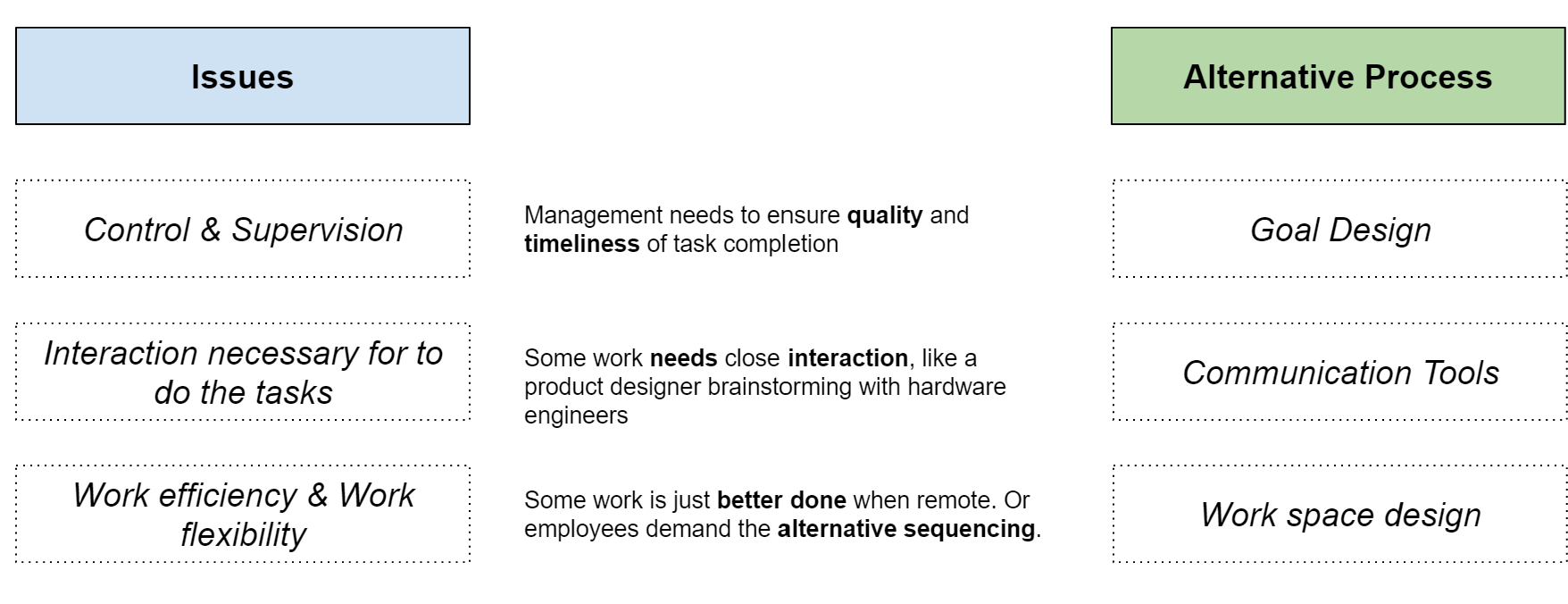
Workflows and other issues for remote work
On the right, the issues. The sum of what we discussed before. A small explanation next to it. On the right, the alternative design or process.
What is the best software stack for remote work?
Well, what do we need?
Certainly a way to communicate ad-hoc, the options here are obvious: Email, Zoom, WhatsApp, Slack, Wherby, whatever.
A way to manage information and set goals, and manage task - tools like Asana, Notion, Code, Google Docs, Office, Airtable are of great use. A variety of OKR and goal management software complements this.
A way to have space to work in - WeWork, tax deductions for home offices under German law, Co-Working spaces.
The technology is there, what is missing?
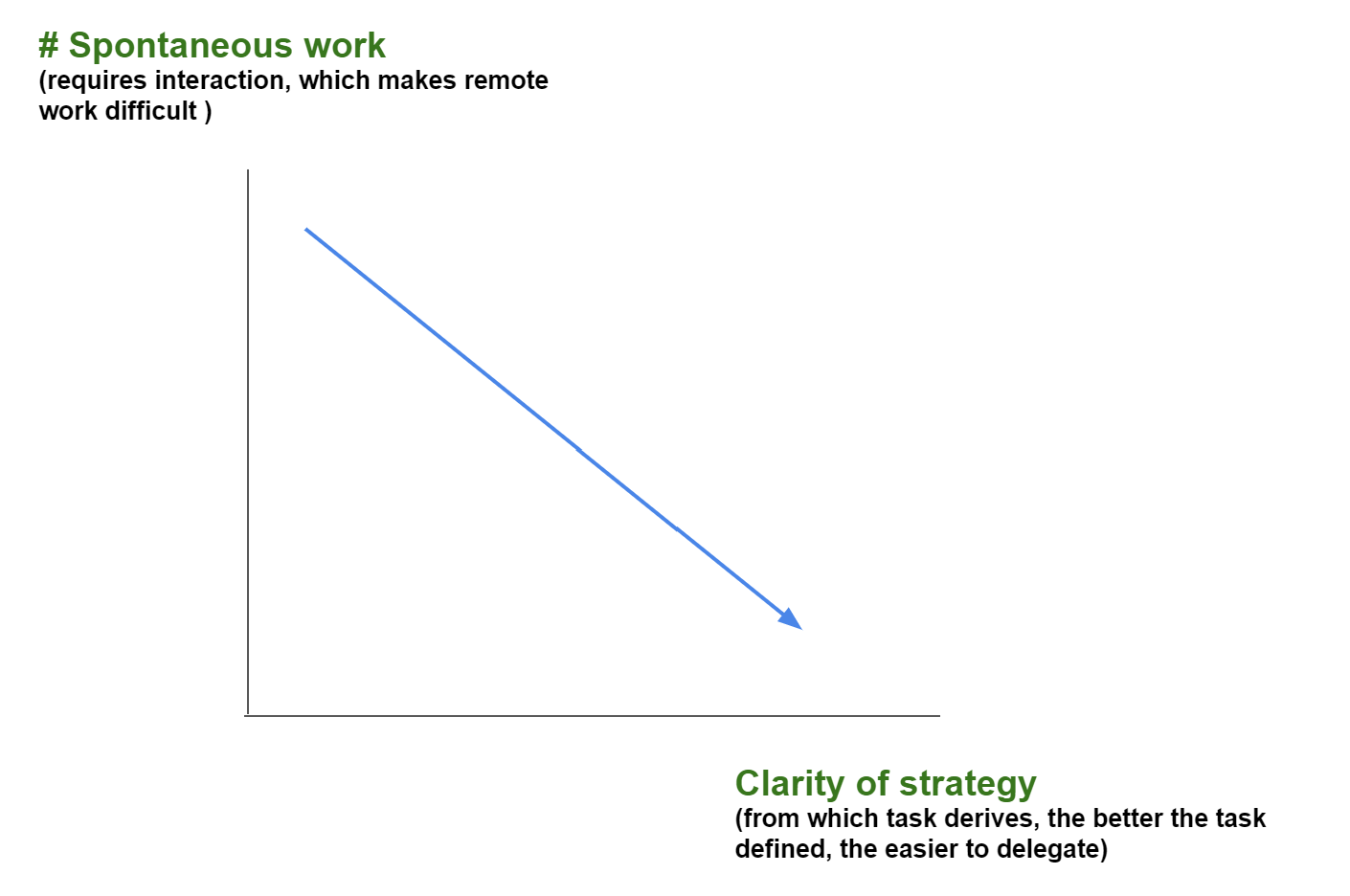
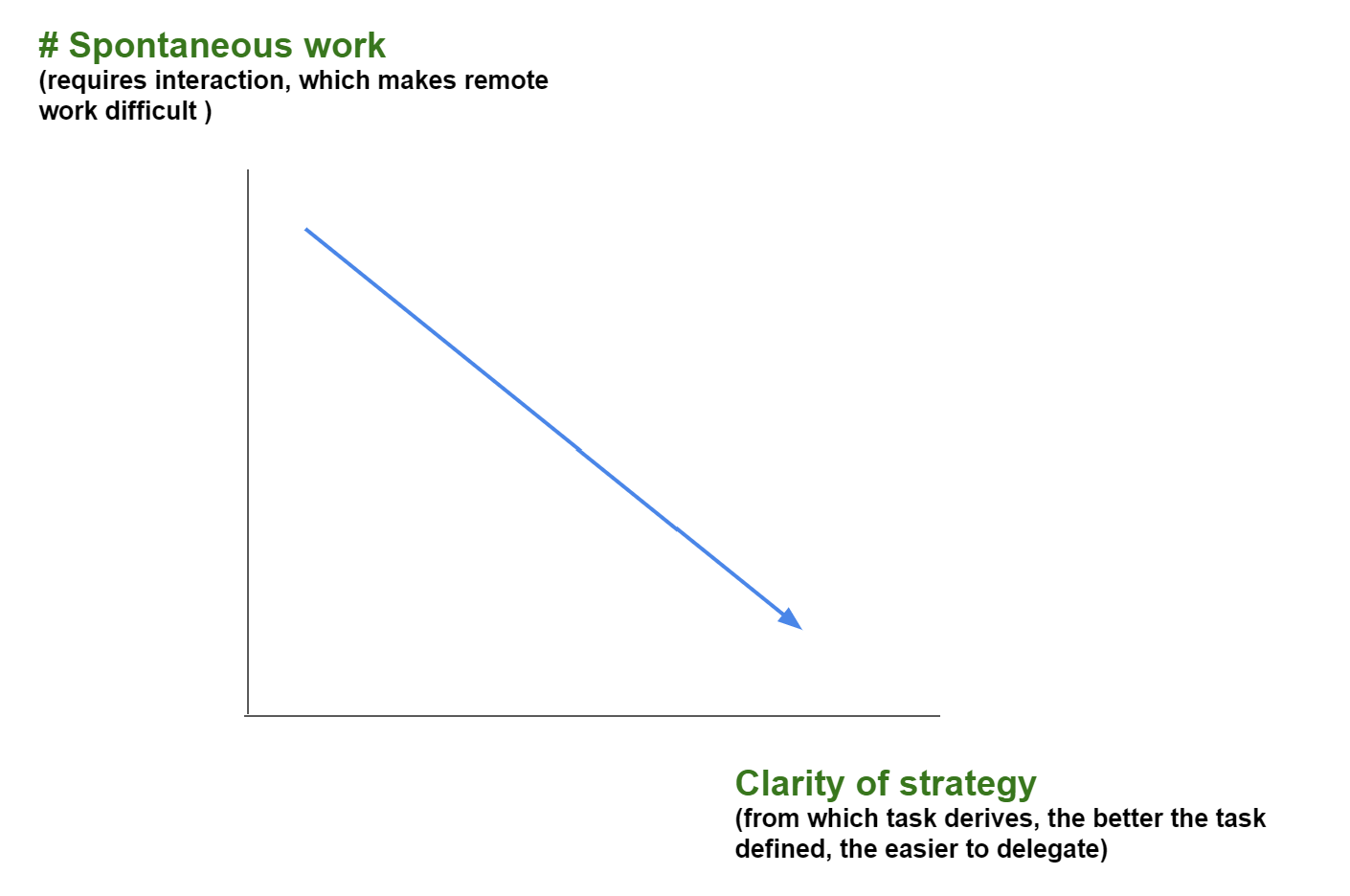
Strategy. It is very difficult to design goals good enough to make work delegatable so that remote work is feasible. The lack of well designed goals derives from a lack strategy.
Trust. Management does need to trust into a) the goals it set and b) the employees doing them. That is very difficult and needs to be learned.
Who is the product manager?
Defining a product manager is difficult. "Voice of the customer", "CEO of a Product" is hard to translate into a measurable metric. In this piece I argue that the product manager is the person who is responsible for the timeline of the launch of a new product. All trade-offs come down to time - the product manager is the person that is accountable for the timeline.
I wrote this blogpost in 52 minutes (stopped the time) - please help me improve it by pointing out grammar, wording.
Nearly all organisations have somebody called “product manager”. The question is - what makes a product manager. A new product is launched for one of two reasons:
Generate Profits / increase absolute contribution = (price - unit cost) x (units sold) - (fixed costs)
Gain Market Share / increase revenue = (price) x (units sold)
Look innovative for M&A / this is a special scenario in which you are betting to sell the company, applies to venture capital and growth companies in particular. Not the focus of this article.
Product management: given a problem - how to solve it
As a product manager you want to achieve either profits or revenue. The product and the features of the product is designed to match these goals. Everything that goes beyond is excess. Which problem is being solved by the features defines the market and is a company strategy decision, not a product management decision. Example: do you want to solve the problem of small and midsize companies, of individuals or of large companies.
Product management maps the features to the customer group chosen by the company strategy, works on the sales forecasts and matching marketing plans. So far, so good.
The problem with product management is that you can essentially iterate until infinite without solving. There is always room for improvement. You can always improve something in the App, change the packaging. This, of course, it is much more comfortable than do the hard work of generating leads and selling the problem because that could lead to failure - a customer saying no.
We are missing the crucial variable that makes the product manager: time.
Ultimately, the product manager is the person that owns the time
From a company perspective, there is certainly a plan (revenue or contribution margin) behind the product launch.
This plan has three components: the price, the units sold and when we start selling the new product. We assume the price and the number of units sold as fixed. What remains is the timeline.
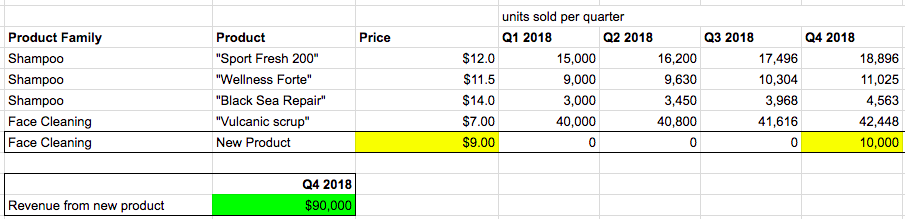
Let's take a company with two product groups: shampoo and face cleaning. The goal is to increase revenue because the company is interested in market share.
That simply means: (units sold) x (price) = revenue. As outlined in the example plan.
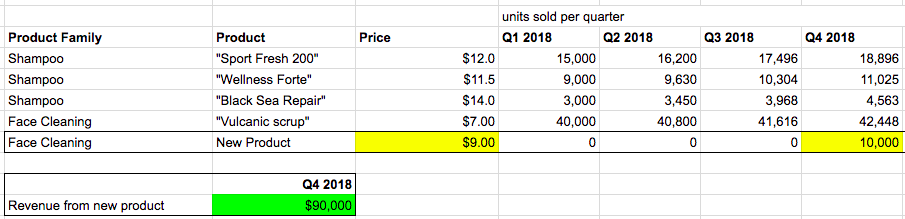
Now, obviously, if the product is not launched, then there will be no revenue from that product. Simply because what is not ready cannot be sold. The cost of a delayed launch is 90,000$.
Time is a crucial insight because the amount of features and the technology used are often only limited by time. Time simply translates to money and all trade-offs must be made against the money that is lost when a product is launched late.
In addition, the time spend pondering some features also costs money because the company is paying somebody to do that. This money is no longer there to build the features or to market the features to potential customers. So we loose money by not being able to sell and we loose money by paying the people doing the development.
If you are accountable for the lost revenue because of the late launch, than you are the product manager. If you are not accountable towards that revenue, than you are not a product manager.
I am the product manager for my blog (without revenue) that’s why I noted the time at the top, so I know how long it takes to launch a new features - this blog post.

Sales Channels for Product Managers
This post combines brings together the price of a product, the sales mechanism, the commission for sales staff and the market size to give a holistic way of thinking about the product. Recommended for product managers.
Companies are usually founded to eliminate some type of problem the founders care about. The product the company makes solves that problem and in return for customers pay the company. In other words: a company sells a product.
How exactly the selling happens is extremely important to the company because it shapes the product and the company and consequently if the shareholders of the company are happy. But, it is very rarely explained what criteria to use when choosing a sales channel.
What follows is my best understanding these criteria. The focus is on the mechanisms more than on the exact numbers. As per usual, this is written fast and the result of my mistakes
Types of Selling for Product Managers
If you look at sales channels or method, there are a variety of methods. The grouping here is between direct and indirect. Indirect is anything where you are not selling directly to the customer but selling via some other party.

This is an example of self service
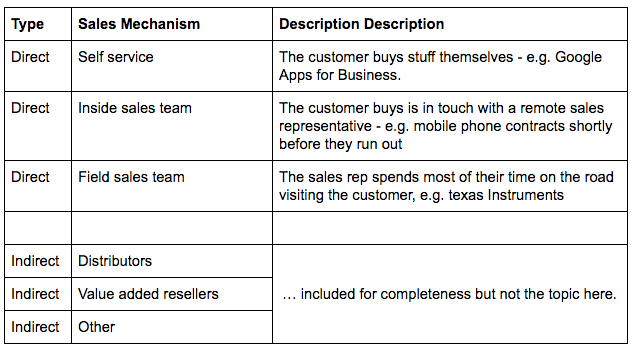
Direct sales (where you can engage with the customer directly) are divided into self service, inside sales team and a field sales team.
As an end-customer you deal mostly with self service type of sales environments - i.e. you do not talk to a human before purchasing.

A direct sales approach. Vorwerk vacuum cleaners.
Sometimes you will talk to a human on the phone, for example in the case of insurance or just before your mobile phone contract runs out - this is called inside sales team.
An outside sales team, i.e. people who visit you, are unfortunately not called outside sales teams but field sales team or field reps.
In private life I have only met field sales teams from Jehovahs Witness’ and expansive vacuum cleaners - the picture on the left is in fact from the company presentation of Vorwerk.
Vorwerk calls this "direct sales", I call it "field sales". The world ultimately does not care what you call things but how you understand them, so below you find the summary and description.
Types of Sales
Sales for Product Managers
We will take too approaches to get to the question. First, bottom up: i.e. starting from the cost of a Sales Person. Second, top down, understanding the same question from a company strategy perspective.
Bottom-up: what can you afford?
Before I go further here, I want to admit that I have limited experience selling. I have done both on the phone selling (really badly in my own start up), technical sales support in b2b and field sales but I am in no way an expert and have done each for less than a year.
A salesperson, both inside and field, is compensated through commission. The commission is determined by three things:
a) how many customer interactions do I have
b) what is the likelihood of a closed sales
c) what is the commission for the sales rep at each win
Let’s build the case backwards. Market rate for a high performing sales rep (regardless of inside or field) is 30k Euro fix and with another 40k variable on hitting the sales quota.
The math checks out like this:

How leads convert to commission
Leads: those are simply the amount of people the sales rep engages. For an inside rep I just assumed 30 leads per day and 20 working days. (That means your marketing needs to generate 600 fresh leads per month!). For field sales I assumed 10 leads per day (think about what product Vorwerk is selling).
Win Ratio and Wins: This is just the assumed ration from the interactions. It will depend on your product and qualification but 7% is rather high. Wins is just the the % of the leads.
Commission per Month on Target: as we have discussed before, we need to be able to pay a salesperson 3.3k$ commission per month (40k/12 Months) because that’s the the market rate for this type of labour.
Commission per Sales: this is simply 3.3k$ divided by the number of wins. That gives us how much commission we need to pay per win.
Check and Balances - Unit Economics
So, can we pay commission of 79$ or 238$? Well, this depends on your unit economics.
First, let’s assume we are selling software. Our target gross margin is 65% (See damodaran gross margin tables). That means producing and selling the product is <35% of the price.
If we set the cost of making the product and generating to 0 than the minimum price is: (commission) * (1/0.65). Obviously, that is a crazy assumption because we are not not spending any money on lead generation which will be key to maintain your sales team. Plus there is no budget for running the product, for example AWS fees, etc. This is a crazy assumption used to make the point.

Margin and product price
The answer:
In short, given the above assumptions if you product is below 122$ then inside reps make no sense. If you product is below 366$ then field sales makes no sense.
Cour product margin or conversion rates need to be higher or your sales people need to be cheaper to make it a good business.
But Customer Lifetime?
The lazy way out of this debate is to argue - once I have a customer, he will stay until infinity (e.g. in case of Netflix) or he will buy more stuff from me. That is a lazy argument and not valid until proven otherwise.
Top-Down Sales Strategies for Product Managers
This part begins with the interest of the shareholders. If you own the company yourself than obviously you can do whatever you want. But, let’s assume you are venture capital backed and need to grow a unicorn.
The product is still software, so we know the enterprise revenue to sale multiple. It is about 7 times revenue. To be a billion dollar company we need to do about 1 billion / 7 = 150m $ revenue.
The math looks like this:

Market Size for Product Managers
Let’s assume you can do 10% market share. Whatever you are selling, is the market size at 50$ for your product 30m customers? Be critical about this, even when you are selling something that costs 500k per year you will need 300 customers to achieve the returns you promise to achieve.
The rest of the math stays the same. Pay market rate and control for unit economics margin.
Conclusion:
Why are mobile phone contract sold with inside sales reps? Because the cost of a mobile phone contract is essentially 0 - except for the cost of the sales person. A 2 year contract at about 50$ a month is worth 1,200$ and the likelihood of buying is high because everybody needs one.
Also: make conscious decisions about your price and sales mechanism.
Electric Cars
5 Years ago it, the discussion was: a) there are not enough batteries in the world, b) customers won’t buy b/c range anxiety